Is it worth pursuing an MBA in US in 2027?
Yes—but only if you can name the career outcome the MBA will unlock and can afford the downside if U.S. work authorization does not go your way. For an Indian applicant targeting consulting, investment banking, corporate strategy, product leadership, or a significant geography/function switch, a top U.S. MBA beginning in 2027 can still be a powerful accelerator. It is not, however, a default “study abroad” decision or a guaranteed route to a U.S. career.
Is an MBA in the USA Worth It for Indian Students in 2027?
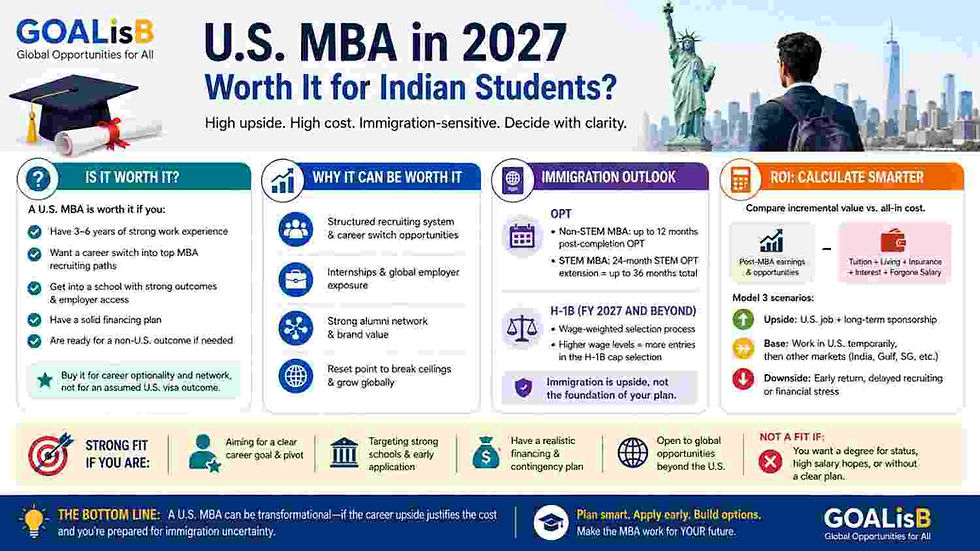
A U.S. MBA in 2027 is worth serious consideration if most of these are true:
You have roughly 3–6 years of strong, progressively responsible work experience by matriculation.
You want a structured pivot into MBA-recruiting-heavy paths—especially consulting, investment banking, leadership-development programmes, corporate strategy, or certain product/finance roles.
You are competitive for a school with consistently strong employment outcomes, employer access, alumni depth, and international-student support.
You have a credible financing plan and can handle a scenario in which you return to India, the Gulf, Singapore, or another market after graduation.
You are comfortable treating immigration as upside, not the foundation of the investment case.
Do not do it in 2027 merely for an international degree, a salary headline, or because peers are applying.
Why Can a U.S. MBA Still Be Worth It in 2027?
The main value of a leading U.S. MBA is not the classroom curriculum. It is the combination of:
A formal recruiting system that can enable a career switch.
Internship access during the programme.
A strong alumni network and brand portability.
Higher-quality exposure to global employers, investors, founders, and operators.
A reset point for people who have hit a ceiling in their current role or geography.
For someone with interests in finance, strategy, business research, education technology, and entrepreneurship, the U.S. can be especially compelling if you want to build toward:
Investment banking, corporate finance, equity research, asset management, or investor relations.
Management consulting or internal strategy roles.
Product, growth, operations, or business-side leadership in technology and AI-enabled companies.
Education-business entrepreneurship, where a global peer network, fundraising exposure, and product ecosystem can be valuable.
But the degree is most valuable when it creates an opportunity you realistically cannot access through direct hiring, a specialised master’s, an Indian MBA, or building your business directly.
How Does Immigration Risk Affect the Value of a U.S. MBA in 2027?
For international students, especially Indians, the U.S. visa path needs to be treated as a material financial and career risk.
Most non-STEM MBA graduates typically receive up to 12 months of post-completion Optional Practical Training (OPT). Students with qualifying STEM degrees may be eligible for a 24-month STEM OPT extension, creating a potential 36-month work window—so confirming whether your specific MBA programme and degree classification is STEM-designated is crucial before you apply. USCIS makes clear that the extension is for qualifying STEM degrees and has specific eligibility requirements.
The H-1B route is not assured. The statutory annual cap remains 65,000 regular H-1B visas plus 20,000 under the U.S. advanced-degree exemption. USCIS also says it has implemented a wage-weighted selection process from FY 2027, favouring registrations tied to higher wage levels; that makes compensation, job type, and employer sponsorship behaviour more important than before.
So the right framing is:
“Would this MBA still make sense if I had to build my post-MBA career outside the U.S. after OPT?”
If the answer is no, the financial exposure is probably too high.
How Should You Calculate the ROI of a U.S. MBA?
Do not use average salary figures. Build a personalised downside-case model.
Question | A strong “yes” | Warning sign |
Target outcome | A defined post-MBA role, such as IB associate, consulting associate, strategy manager, or product manager | “I will explore once I get there” |
School quality | Clear recruiting strength for your target sector and geography | Choosing primarily by ranking, location, or lower GMAT/GRE threshold |
Funding | Savings, scholarship, sponsor support, or manageable borrowing | Financing almost everything through expensive debt |
Career history | Evidence of leadership, impact, and a coherent progression | MBA used to compensate for a weak or unclear profile |
Visa contingency | Viable India/global plan after graduation | Plan assumes H-1B sponsorship and permanent U.S. employment |
Opportunity cost | You are leaving a role that has plateaued or blocks your switch | You are exiting a high-growth trajectory without a clear reason |
Use this simple comparison:
\text{Incremental career value} =
\text{post-MBA earnings and opportunities}
-
\text{earnings you would have had without an MBA}
Then compare that incremental value against:
\text{All-in cost} =
\text{tuition + living costs + health insurance + loan interest + forgone salary}
For a two-year U.S. MBA, do this under three scenarios:
U.S. upside case: You secure a target job, work on OPT, and obtain longer-term sponsorship.
International-base case: You work in the U.S. temporarily, then move to India or another market.
Downside case: Recruiting is delayed, you use savings or debt servicing becomes difficult, and you return earlier than planned.
Only proceed if the international-base case is still acceptable.
Which Indian Applicants Should Apply for a U.S. MBA in 2027?
Who Is a Strong Fit for a U.S. MBA in 2027?
You should seriously consider a 2027 intake if you are:
A consultant, banker, analyst, engineer, product professional, operator, entrepreneur, or family-business professional with demonstrable leadership and impact.
Seeking a true function or industry transition.
Targeting top programmes or schools that are particularly strong in your desired field—not simply any U.S. MBA.
Able to apply early and invest in a strong GMAT/GRE, essays, recommendations, and career narrative.
Prepared to take recruiting seriously from the first week on campus.
For a 2027 intake, many leading schools typically have Round 1 deadlines around September–October 2026 and Round 2 deadlines around January 2027. For example, the published 2026–27 cycle deadlines listed HBS Round 1 on September 9, 2026, Wharton on September 8, Stanford GSB on September 9, Booth on September 15, and MIT Sloan on September 29.
Who Is a Weak Fit for a U.S. MBA in 2027?
Pause or reconsider if you are:
Applying with fewer than about two years of meaningful full-time experience, unless pursuing a deferred-admission route.
Unclear on why you need an MBA now rather than after another 1–3 years of work.
Choosing the U.S. only because you expect high salaries.
Borrowing at a level where an India-return outcome would create major repayment stress.
Targeting jobs that do not recruit meaningfully from your intended schools.
Unable to explain a credible story connecting your past, MBA, and post-MBA goal.
How Should You Approach a U.S. MBA Application for 2027?
If you decide to pursue it, take a portfolio approach, not an all-or-nothing prestige approach.
Build a school list around function, location, alumni depth, international placement, scholarship potential, and STEM designation—not rankings alone.
Prioritise Round 1 where possible. It gives more time for visa processing, scholarship consideration, and contingency planning; advisers also recommend applying early given potential processing uncertainty.
Ask every school direct questions: What percentage of international MBA students receive offers? Which employers sponsor? How does the career office support OPT and H-1B navigation? What proportion enter your target industry?
Speak to at least 5–10 current students or alumni in your target function, particularly Indian or international alumni from the past two graduating classes.
Negotiate and compare scholarships aggressively. A slightly lower-ranked school with a substantial scholarship and stronger access to your target employers can beat a higher-ranked, full-debt option.
Keep a parallel career plan for India and Asia. A U.S. MBA brand can be valuable in India, but the value differs greatly by school, role, and your pre-MBA track.
So, Is a U.S. MBA Worth It for Indian Students in 2027?
A U.S. MBA in 2027 is a high-upside but high-cost and immigration-sensitive investment. Do it if it is the most credible way to access a specific career transition, you can attend a genuinely strong programme for that outcome, and you can financially survive a non-U.S. outcome.
For an Indian candidate, the best decision rule is simple:
Apply if the MBA gives you a compelling global career and remains financially sensible even if you return to India after OPT.
Wait if you need stronger work experience, leadership evidence, or test scores to reach a better school and scholarship outcome.
Choose another route if your goal can be reached more cheaply through direct job switches, Indian/European programmes, specialised degrees, or building your own venture.
The degree can still be transformational—but in 2027, it should be bought for career optionality and network, not for an assumed U.S. visa outcome.
What Is the OPT and H-1B Visa Outlook for International MBA Students?
For international MBA students, the outlook is mixed but still workable: OPT remains the essential bridge into U.S. employment, while H-1B has become more favourable to higher-paid, more experienced hires and less forgiving for entry-level roles. The practical implication is that a STEM-designated MBA, a sponsor-friendly employer, and a strong early-career salary are now more important than ever.
What Is the OPT Outlook for International MBA Students?
Standard OPT
An F-1 student completing a U.S. degree can generally seek up to 12 months of post-completion OPT in work directly related to the field of study. This is the standard work-authorisation route after an MBA.
For a conventional, non-STEM MBA, this one-year window is often tight:
You begin post-MBA work around June–August.
Your employer would usually need to register you in the next H-1B cap season, generally in March.
If selected and approved, H-1B status typically starts on October 1.
If not selected, you may have limited remaining work-authorisation time and may need to depart, transfer to another status, or pursue an alternative visa path.
STEM OPT: the key advantage
If your actual awarded MBA degree is STEM-designated and appears in the eligible STEM field framework, you may apply for a 24-month extension after the initial 12-month OPT—creating up to 36 months of total OPT. USCIS requires, among other things, that the student have an eligible STEM degree, hold initial post-completion OPT, work for an employer using E-Verify, and satisfy the STEM training-plan requirements.
For a 2027 MBA applicant, this is why STEM designation is financially important:
MBA type | Potential post-study work period | H-1B attempts before OPT expires |
Non-STEM MBA | Up to 12 months | Often effectively one |
STEM-designated MBA | Up to 36 months | Usually up to three |
STEM MBA + cap-exempt employer | Potentially avoids the annual cap route | Depends on employer and role |
Do not assume that a programme calling itself “analytics-focused,” “digital,” or “tech-oriented” qualifies. Check the school’s current CIP code, the exact degree awarded, its STEM eligibility, and whether international students have actually obtained STEM OPT using that degree. Ask the school’s international-student office in writing before accepting an offer.
Cap-gap protection
If a cap-subject H-1B petition is timely filed for an eligible OPT holder, “cap-gap” rules can extend F-1 status and, in qualifying cases, work authorisation until April 1 of the relevant fiscal year. This protection is useful, but it is not a substitute for being selected in the first place.
What Is the OPT Outlook for International MBA Students?
The system is now wage-weighted
The most significant change is that the old purely random cap selection system has been replaced by a wage-weighted process. The final rule took effect on February 27, 2026 and applied to the FY 2027 registration season.
In simplified terms, an H-1B registration receives more entries in the selection process when the offered pay meets higher Department of Labor prevailing-wage levels for the relevant occupation and geographic area:
Wage level | Entries in selection pool |
Level I | 1 |
Level II | 2 |
Level III | 3 |
Level IV | 4 |
This does not mean that every highly paid MBA graduate is selected, nor that lower-paid candidates are barred. It means the process structurally improves selection odds for jobs offered at higher wage levels and worsens the relative odds for entry-level, lower-compensated, or lower-cost-market roles.
What this means for MBA careers
This change is relatively favourable for MBA students targeting roles with high post-MBA compensation and established sponsorship practices:
Investment banking and certain capital-markets roles.
Management consulting.
Corporate finance and strategy at large companies.
Product, programme, operations, or commercial roles that are genuinely specialised and pay competitively.
Some technology, analytics, and business-transformation roles.
It is more challenging for:
Start-ups that lack immigration infrastructure or cannot pay at competitive prevailing-wage levels.
Small companies without established sponsorship experience.
Generalist, lower-paid, or ambiguously specialised business roles.
Roles where the employer does not see a clear connection between the MBA and the job’s specialised requirements.
That last point matters: H-1B requires a qualifying specialty occupation. A generic “business manager” job title with vague duties can be harder to sponsor than a clearly defined analyst, finance, strategy, technical product, quantitative, or specialised consulting role.
What Does the FY 2027 H-1B Cap Season Tell MBA Applicants?
The first wage-weighted cycle was not “easy.” USCIS filled both the 65,000 regular-cap places and the additional 20,000 U.S. advanced-degree exemption places for FY 2027. The cap was reached by July 17, 2026, and USCIS did not hold a second selection round.
There were reportedly 211,600 properly submitted FY 2027 registrations, versus 343,981 in FY 2026. That lower registration volume may reflect anti-fraud measures, employer behaviour, and the new selection framework, but it should not be read as a guarantee of good odds for any individual MBA graduate. USCIS had not published an overall selection-rate breakdown in the reporting cited.
For someone entering a two-year MBA in autumn 2027 and graduating in 2029, the relevant cap seasons will likely be FY 2030 and beyond. The exact rules can still change before then. Treat the FY 2027 structure as the current baseline—not as a permanent promise.
What Is the Best H-1B Strategy for International MBA Applicants?
Prioritise these factors
Choose a truly STEM-designated MBA where it also makes academic and career sense. The potential 36-month OPT window materially reduces the all-or-nothing nature of the H-1B decision.
Target employers with a visible history of sponsoring international MBA hires. Ask career services for actual sponsor lists, not broad assurances that “many employers hire internationals.”
Recruit for roles with clear professional specialisation and compensation aligned with at least a strong prevailing-wage benchmark in the job’s city.
Start sponsorship discussions early. By offer stage, confirm whether the employer will support OPT, STEM OPT where applicable, H-1B registration, and future green-card sponsorship.
Build a real non-U.S. contingency plan: India, Gulf markets, Singapore, London where eligible, or internal transfer opportunities. It should be career-positive, not merely a forced exit route.
Do not borrow assuming that three H-1B attempts will necessarily be available. STEM OPT improves your runway; it does not create an entitlement to selection, sponsorship, or approval.
What Does the H-1B Wage-Weighted Rule Mean for U.S. MBA Applicants?
For a 2027 entrant, the U.S. pathway remains viable—but it is no longer sensible to treat it as “MBA → job → H-1B” by default. The strongest profile is:
STEM MBA+ sponsor-ready employer + well-paid specialised role + global fallback plan
A non-STEM MBA can still make sense for elite consulting, banking, and major corporate roles, but it carries substantially greater timing risk because the usual OPT runway is only 12 months. A STEM MBA gives you time; a high-quality job and employer sponsorship give you probability; and an international career plan protects the investment if U.S. policy or selection outcomes change.
How Does the H-1B Wage-Weighted Selection Rule Impact MBA Graduates?
The wage-weighted H-1B rule makes the U.S. post-MBA path more favourable for graduates entering well-paid, specialised, sponsor-friendly roles—and less predictable for those entering lower-paid or loosely defined general-management jobs. For MBAs, the core change is simple: the salary level of the offered job now affects the number of chances you receive in the H-1B cap selection process.
What changed in the H-1B Selection Process for FY 2027?
Beginning with the FY 2027 H-1B cap season, DHS replaced the purely random H-1B selection lottery with a weighted process. The policy is designed to favour higher-skilled and higher-paid foreign workers, while technically retaining eligibility across all wage levels.
The employer identifies the role’s Standard Occupational Classification (SOC), work location, and offered wage. USCIS then maps that wage to the relevant Department of Labor Occupational Employment and Wage Statistics (OEWS) wage level.
OEWS prevailing-wage level | Weight in selection pool | Practical implication |
Level I | 1 entry | Lowest relative odds; often associated with entry-level roles |
Level II | 2 entries | Better odds than Level I |
Level III | 3 entries | Strong relative position |
Level IV | 4 entries | Highest relative odds |
The weighting is tied to the wage offered for the specific occupation and area of intended employment—not simply the employer’s prestige, your MBA brand, or how demanding the role sounds. A higher salary in New York may not map to the same wage level as that amount in Dallas, Chicago, or a smaller U.S. market.
Why Does the Wage-Weighted H-1B Rule Matter for MBA Graduates?
An MBA typically leads to a higher-paying role than a fresh undergraduate or master’s hire. That gives many MBA candidates a structural advantage—if they recruit into post-MBA roles where pay genuinely reaches Level II, III, or IV for the particular occupation and location.
Which MBA Career Paths Are More Favourable Under the New H-1B Rule?
These tend to have the strongest alignment with the new rule because compensation is high and roles are comparatively easy to describe as specialised professional occupations:
Investment banking, capital markets, corporate banking, valuation, and some buy-side roles.
Management consulting and strategy consulting.
Corporate finance, strategic finance, FP&A leadership tracks, and internal strategy.
Product management, business operations, programme management, and transformation roles at large technology or industrial firms—where the role has defined analytical or technical requirements.
Leadership-development programmes at large employers, assuming they sponsor and the pay supports a higher wage level.
A post-MBA associate position at a major consulting firm or investment bank will often be much better placed than an entry-level analyst role, because its compensation and responsibility level are usually higher. But “often” is not “automatically”: wage levels depend on the job’s SOC and city-specific prevailing-wage data.
More difficult MBA paths
The rule increases relative risk for:
Start-ups, especially early-stage companies that cannot offer wages above entry-level prevailing wage benchmarks or do not sponsor H-1Bs.
Smaller firms with thin HR and immigration infrastructure.
Generalist “business manager,” “operations manager,” or “commercial manager” roles that have vague duties or inconsistent degree requirements.
Lower-paying social-impact, education, nonprofit, retail, and smaller-company operating roles.
Post-MBA jobs in expensive cities where a seemingly high salary still corresponds to a lower wage level for that occupation.
The risk is twofold: lower wage levels mean fewer weighted entries, and a broad role may face more scrutiny over whether it qualifies as an H-1B specialty occupation.
What Do the New H-1B Selection Odds Mean for MBA Graduates?
A Level IV candidate gets four entries where a Level I candidate gets one. That improves relative probability, but it does not guarantee selection.
For illustration only, suppose the effective probability associated with one entry in a given year were 20%. A candidate with two entries would have better—not necessarily exactly double—odds; a candidate with four entries would be materially better positioned, but could still miss out. Actual odds depend on the annual mix of registrations across wage levels, so there is no universal percentage that a school, employer, or consultant can promise.
The rule also prevents gaming through multiple employer registrations:
USCIS considers each beneficiary once, not once per registration.
Multiple registrations do not multiply your entries.
If multiple employers register the same person at different wage levels, USCIS uses the lowest wage level among those registrations to determine that person’s selection weight.
This has a practical consequence: accepting or maintaining a low-wage alternative registration can potentially pull down the weighting that applies to your candidacy. Do not make decisions around that without tailored advice from an immigration lawyer and the relevant employers.
How Should MBA Candidates Prepare for the Wage-Weighted H-1B System?
Before choosing a school
Give meaningful preference to STEM-designated MBA programmes. STEM OPT can provide up to 36 months of work authorisation, which may allow several H-1B cap attempts rather than the compressed timeline of standard 12-month OPT. This does not improve the H-1B selection weight itself, but it gives you more chances across cap seasons.
Compare schools by historic employer sponsorship, not just employment-report salary averages.
Identify which firms recruit international students into your target function, and whether they sponsor at the associate/manager level.
During MBA recruiting
Prioritise roles with clearly specialised work: financial analysis, corporate finance, consulting, data-led strategy, product, technology transformation, risk, or industry-specific operating roles.
Inquire about sponsorship early enough to avoid investing months in a process with an employer that will not support H-1B registration.
Ask HR or the immigration team—not only a recruiter—whether the company supports OPT, STEM OPT, H-1B cap registration, and green-card sponsorship.
Do not assume a high base salary alone guarantees a high wage level. The employer’s legal team should confirm the relevant SOC classification, worksite, prevailing wage, and wage level.
Plan your finances conservatively
Model three outcomes:
Scenario | What to assume |
Best case | You enter a sponsor-friendly, high-wage role and are selected early |
Base case | You use most or all of available OPT and require multiple H-1B attempts |
Downside case | You are not selected and move to India, the Gulf, Singapore, Europe where eligible, or another company geography |
A U.S. MBA is most defensible when the downside case still preserves career momentum and allows you to service education debt without depending on continued U.S. employment.
What Does the New H-1B Rule Mean for the Value of a U.S. MBA?
The rule benefits MBAs selectively rather than universally. It rewards the profile below:
Strong MBA brand + STEM OPT runway + sponsoring employer + high-wage specialised role
It penalises the opposite profile: a non-STEM MBA graduate relying on a lower-paid, generic role at an employer with uncertain sponsorship.
So, when assessing a U.S. MBA for 2027, do not ask only, “What is the average post-MBA salary?” Ask: “For my exact role, city, employer, and salary, what wage level is likely—and does the employer reliably sponsor people like me?”