ISB PGP Reapplication - Is It Worth Trying Again?
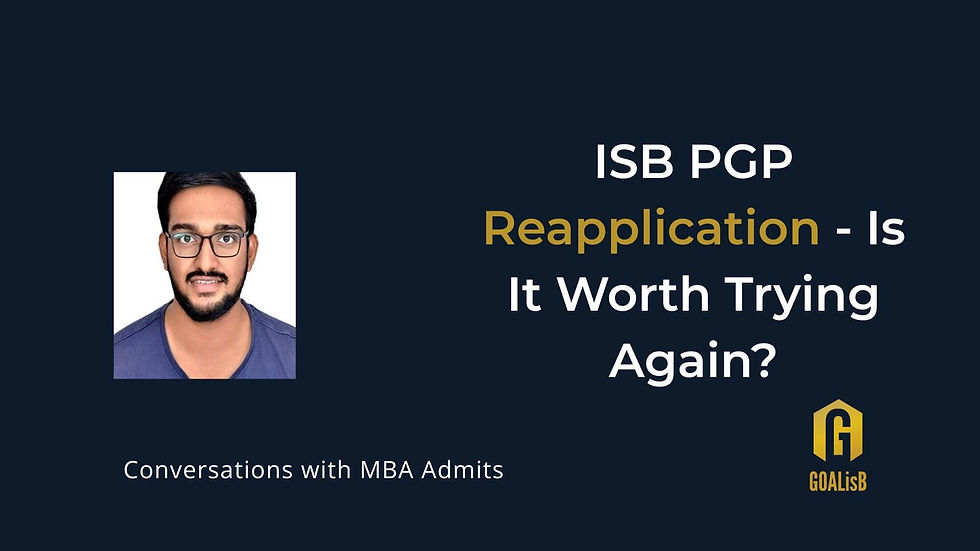
In 2023, Pronoy Das applied to ISB PGP. He had a GMAT score of 645, an IIT Dhanbad degree in environmental engineering, experience at Tata Steel and as a business analyst, and a non-linear career that included two serious UPSC attempts. He did not make the ISB PGP cut then. He worked with GOALisB ISB admission consultants on that application. The rejection arrived, and the first thing he did was ask a question that most people in that situation do not ask with enough precision: not why did ISB reject me, but what specifically was missing and is that something I can fix?
Latest ISB MBA Deadlines (2027 Intake):
ISB PGP Round 1: 20 September 2026
ISB PGP YL Round 1: 20 December 2026
ISB PGPpro Round 1: 23 August 2026
ISB PGPMAX Round 1: 20 August 2026
ISB PGP MFAB Round 1: 29 November 2026
Get started with your ISB application and ISB interview with GOALisB ISB admission consultants.
The ISB PGP admission process at ISB Hyderabad evaluates candidates across multiple dimensions, academic background, GMAT score, work experience, leadership evidence, essay quality, and interview performance. Of those dimensions, GMAT is the one most candidates focus on when they do not get through. It is also, in most cases, not the primary reason a strong profile does not convert. ISB MBA admissions committees are not sorting by GMAT score alone. They are building a class, a specific cohort with a specific mix of backgrounds, capabilities, and leadership evidence.
A 645 GMAT from an IIT graduate with genuine analytical skills and diverse work experience is not the problem. The problem is what the rest of the application can and cannot demonstrate. Pronoy understood this. What he did with that understanding is the reason he is headed to ISB. Watch Pronoy Das's ISB PGP admission story on the GOALisB YouTube channel. This is the complete account, the ISB application, the gap he identified, the two years that followed, the GMAT retake, the ISB interview, and the admit.
An ISB PGP rejection is a diagnosis, not a verdict. Pronoy Das applied to ISB Hyderabad in 2023 with a 645 GMAT, identified the specific gap in his profile, insufficient demonstrated leadership, spent two years as an Entrepreneur in Residence at a startup to address it directly, retook the GMAT and scored 655, applied in Round 1 in 2025, and earned his ISB PGP admit. The ISB admission process rewards candidates who understand what the program is evaluating and respond to it specifically.
What does ISB Hyderabad actually look for in an ISB PGP application?
ISB PGP looks for leadership evidence that is demonstrated, not claimed — specific instances of ownership, accountability, and impact that can be probed in an ISB interview and verified through letters of recommendation.
This is the distinction that most ISB MBA applicants who do not make the cut on their first attempt miss. The ISB admission process is not a checklist. It is an evaluation of whether a candidate can articulate, with precision and honesty, what they have led, what they built, what it cost them, and what it taught them. A resume that lists responsibilities is not the same as an application that demonstrates leadership. The ISB application process — through its essay questions and interview format — is specifically designed to surface the difference.
Pronoy's 2023 profile had genuine strengths. An IIT Dhanbad environmental engineering degree. Management experience at Tata Steel. Two serious UPSC attempts that demonstrated ambition and discipline. A developing analytics competency from his business analyst role. A non-linear career that, properly presented, is more interesting than a straight corporate track. What it did not have was evidence of having led something with full ownership, of having been the person responsible for building or running something where the decisions were genuinely his and the consequences were genuinely felt.
He applied in Round 3 with one month of preparation time between his GMAT score and the ISB application deadline. The application was the best it could be under those constraints. It was not enough. The ISB PGP admission process is not forgiving of applications built under time pressure, because the essay questions require the kind of genuine reflection that cannot be rushed and panels can tell when it has been.
The diagnosis Pronoy arrived at, working with GOALisB after the rejection, was specific: the profile needed demonstrated leadership, the application needed Round 1 timing, and the LOR needed to come from someone who had observed his work closely enough to speak about it with precision. All three of those things were addressable. He spent two years addressing them.
Why did Pronoy Das choose ISB PGP over IIM programs and what does that choice say about the ISB admission process?
ISB PGP was the right program for Pronoy's specific profile stage because it evaluates candidates on what they have built across their career rather than on where they are in a conventional progression.
The IIM two-year programs and the CAT examination that serves them are primarily designed for candidates in the early years of their careers, within one to three years of graduation. Pronoy had taken a different path. IIT Dhanbad, then Tata Steel, then UPSC preparation across two attempts, then corporate analytics work. By the time he was seriously considering an MBA, he was outside the experience window that IIM two-year programs look for in their younger cohort. CAT was not the right examination for his profile. GMAT was.
ISB Hyderabad's PGP program occupies a specific position in the Indian MBA landscape, it is a one-year MBA that evaluates candidates with three to seven years of diverse experience on the totality of what they have built rather than on a narrow experience range. It is one of the very few top-tier MBA programs in India that is genuinely designed for candidates like Pronoy, IIT backgrounds, non-linear trajectories, diverse sector exposure, and a clear articulation of what the MBA will add to a career that is already moving in an interesting direction. The ISB MBA is not a consolation for candidates who missed the IIM window. It is the right program for a specific type of profile, and Pronoy's was that profile.
The ISB admission process also rewards honesty in a way that many applicants do not expect. The essays are not designed to surface the most polished self-presentation. They are designed to surface the most honest one — the candidate who can acknowledge gaps clearly and articulate how they are addressing them is often more compelling to an ISB admissions committee than the candidate who projects an unbroken record of success. This is why Pronoy's 2025 application, which included an honest account of what the 2023 rejection had taught him and what he had done in response, was stronger than a conventional application from a candidate with no rejection in their history would have been.
How should an ISB PGP applicant approach the GMAT, and what did Pronoy Das's two attempts teach him?
The most important GMAT decision for ISB PGP applicants is not which platform to prepare on. It is whether to give the exam online or in person — and most applicants do not treat this as a strategic decision at all.
Pronoy gave his first GMAT attempt in 2023 online and scored 645. His verbal percentile was 19% — despite answering the majority of questions correctly. He attributes part of this discrepancy to the online format, and his 2025 strategy included a deliberate switch to an in-person test centre. His verbal percentile on the GMAT Focus Edition in 2025 was approximately 82%. The total score improved from 645 to 655. The section-level improvement was the more significant change.
For ISB PGP applicants from engineering backgrounds, the GMAT presents a specific challenge that is worth naming directly. Quant is familiar territory — the type of mathematics tested is well within the range of most engineering graduates, and the comfort with quantitative problem-solving that engineering education develops translates reasonably well. The verbal section is where most Indian engineers lose ground, and losing it there loses it in percentile terms disproportionately. A verbal percentile of 19% on a 645 total score is a signal that ISB admissions consultants and committees read clearly, it raises questions about written communication ability that the application needs to address in other ways.
Pronoy's approach to the 2025 GMAT preparation was to invest specifically in verbal while not neglecting quant, a section he ended up underperforming in during the actual examination despite strong preparation. His recovery in the data insights section, where he scored at the 97th percentile, pulled his total score to a competitive level. His lesson from that experience is both practical and psychological: a weak section performance midway through the GMAT does not end the examination. The decision to fight for every subsequent section rather than concede the attempt is a choice, and it is one that can change the outcome. Test prep resources for ISB PGP applicants are at theunied.com.
What is the ISB application process like and what does Round 1 versus Round 3 actually mean for your chances?
Round 1 is not just earlier. It is strategically different in ways that compound across the entire ISB application process, more seats, more preparation time, a cleaner competitive landscape, and a stronger signal to the admissions committee that you planned seriously.
Pronoy applied in Round 3 in 2023 with one month between his GMAT score and the application deadline. He applied in Round 1 in 2025 with two months of essay development time between his GMAT score and the submission date. The difference in outcome was not entirely a function of the round — his profile was materially stronger in 2025 — but the round shaped everything about how well the application could be built.
The ISB application process involves multiple components: the online application form, GMAT score submission, letters of recommendation, and the essay questions. The essay questions are the most time-intensive component and the one most damaged by time pressure. ISB essay questions ask candidates to reflect on their career, their leadership, their post-MBA vision, and their fit with the ISB MBA program. These are not questions with right answers. They are questions that require genuine reflection — the kind that produces specific, honest, irreplaceable content rather than polished generic content.
One month is not enough time to produce that reflection. Two months, with an experienced ISB admission consultant providing specific feedback across multiple drafts, is. The difference between a Round 3 application built in one month and a Round 1 application built in two is not incremental. It is the difference between an application that reads as considered and one that reads as rushed.
Pronoy's LOR strategy also shifted between cycles. In 2025 he secured a letter of recommendation from his startup founder — an ex-McKinsey consultant who had worked closely with him as both employer and mentor across two years. That letter could speak to his leadership, his decision-making, and his professional development with the specificity that ISB panels look for. It was a direct product of the two years he had invested in building something worth being written about. The GOALisB guidance on LOR selection — specifically the instruction that the recommender should be someone senior who has worked closely with the candidate and observed their leadership directly — shaped that choice.
What is the ISB interview like?
The ISB interview is a probing conversation drawn from the application — not a general discussion about career goals. Every claim made in the ISB application becomes potential source material for the interview panel.
Pronoy's ISB interview, after a brief introduction, moved quickly into an impromptu conversation about his work. What had he done as Entrepreneur in Residence. What decisions had been his. What impact had he generated. How had the startup experience changed how he thought about leadership. These were not generic questions from a standard MBA interview guide. They were specific follow-up questions drawn directly from the content of his ISB application — from the claims he had made in his essays and from the experiences he had cited as evidence of his leadership growth.
Because those claims had come from genuine reflection during the essay process — not from a coaching platform's list of standard ISB interview answers — he could respond with depth and without hesitation. The content was his. He had lived it, examined it in the essay process, and tested it in one mock interview session two to three days before the actual ISB interview. The mock produced one specific piece of feedback that stayed with him: cite real instances rather than preparing standard answers to why ISB and why MBA questions. ISB interviewers have conducted hundreds of interviews. They recognise the difference between a candidate who is speaking from lived experience and one who is delivering a rehearsed answer to a question they anticipated. The former holds up under follow-up. The latter does not.
This is the connection between the ISB application process and the ISB interview that most applicants do not fully understand before they start writing their essays: the essay process is the interview preparation. The clarity, specificity, and honesty that go into the ISB application essays produce the fluency and depth that appear in the ISB interview room. They are not separate tracks. They are the same preparation at different stages. For ISB PGP interview preparation guidance, the GOALisB YouTube channel at youtube.com/@goalisb carries content across applicant profiles and program formats.
Why does working with an ISB admission consultant matter?
For first-generation MBA aspirants, candidates whose families cannot provide informed guidance on what ISB PGP evaluates or how the ISB application process works, an ISB admission consultant is not a supplementary resource. It is the primary mechanism through which the process becomes navigable.
Pronoy is the first engineer in his family and the first individual pursuing an MBA. There was no family network to draw on for guidance about the ISB admission process, about what ISB MBA essays are actually asking, or about what differentiates a Round 1 application from a Round 3 one. His observation on this is direct and worth quoting: everyone has a unique journey, and getting help from a consultant helps curate it according to the application requirements for different schools, because each school has a different strategy and a different set of requirements. The consultant's role is to understand the specific journey — not a generic version of it — and translate it into an application that is competitive for the specific program being targeted.
What GOALisB gave Pronoy across two application cycles was not essay editing. It was strategic direction that arrived at the moment it was most needed — after the 2023 rejection, when the natural response would have been to reapply sooner with a higher GMAT score. The direction was different: identify the specific gap, address it over two years in a role that would produce genuine evidence, return to the ISB application process in Round 1 with a stronger profile and a stronger LOR. That direction shaped the two years between cycles. Without it the 2025 application would likely have been an incrementally improved version of the 2023 one — stronger essays, slightly higher GMAT, same fundamental gap. GOALisB's ISB admission consulting practice is at goalisb.com.
What is GOALisB and how does it approach ISB admission consulting?
GOALisB is an MBA admissions consulting practice led by Shruti Parashar, an ISB PGP alumna from the Class of 2006 with over seventeen years of industry experience. As an ISB admission consultant with direct experience of the ISB PGP program and its admission process, Shruti brings a specific and insider perspective to ISB MBA applications — not only on what the ISB application requires but on what the program delivers and what kind of candidate thrives in it.
The practice works with applicants targeting ISB PGP, ISB PGPpro, ISB PGPMAX, ISB MFAB, IIM Ahmedabad PGPX, IIM Calcutta PGPEX, IIM Indore EPGP, IIM Lucknow IPMX, and global programs including INSEAD, London Business School, Wharton, Chicago Booth, Oxford, Cambridge, NUS Business School, and HEC Paris. GOALisB has a specific track record with reapplicants, first-generation MBA aspirants, non-linear career profiles, and candidates whose journeys do not fit the standard template — the UPSC aspirant who returned to corporate work, the PSU engineer who has never held a private sector role, the analyst who applied to ISB and did not make the cut and needs to understand why before trying again.
Pronoy Das's ISB PGP admit — across two application cycles, a UPSC detour, three career phases, a GMAT retake, and a two-year deliberate profile rebuild — is among the outcomes that illustrate what an ISB admission consulting relationship built on honest assessment and specific strategy produces over time.
FAQ Section
Why do strong candidates get rejected by ISB PGP in the first attempt?
ISB PGP rejection most commonly results from insufficient demonstrated leadership evidence, weak essay specificity, poor round timing, or a misaligned LOR — not from a low GMAT score alone. A 645 GMAT from an IIT graduate with genuine analytical skills is competitive. An application that cannot demonstrate ownership and impact is not.
What GMAT score is needed for ISB PGP admission?
ISB PGP does not publish a minimum GMAT cut-off. Competitive scores for ISB Hyderabad typically fall between 680 and 740. Pronoy Das earned his ISB PGP admit with 655 on the GMAT Focus Edition, supported by a strong profile, specific essays, and a clear post-MBA vision. Section percentiles are evaluated alongside the total score.
What is the ISB PGP interview process like?
The ISB interview is a focused, probing conversation drawn directly from the application. Panels follow threads from the essays, probe claims, and ask follow-up questions to test depth and authenticity. Candidates who have built their essays from genuine reflection perform significantly better than those delivering rehearsed answers to anticipated questions.
Is it worth applying to ISB PGP a second time after a rejection?
Yes. if the second application is materially different from the first. Reapplying with the same profile and a slightly higher GMAT score rarely changes the outcome. Reapplying after specifically addressing the gap that caused the first rejection — as Pronoy Das did over two years — produces a fundamentally different application that the ISB admission process evaluates differently.
What do ISB admission consultants actually do that applicants cannot do independently?
ISB admission consultants provide strategic direction on profile gaps, round timing, LOR selection, and essay development, and the most valuable input is often the honest assessment of what is missing rather than the polishing of what is already there. For first-generation applicants without MBA-literate networks, this strategic input addresses a genuine information asymmetry.
How long does the ISB PGP application process take?
The ISB application process for Round 1 typically opens in June and closes in September. Candidates who have their GMAT score by June or July have approximately two to three months for essay development, LOR coordination, and application refinement. GOALisB recommends a minimum of two months of active application development for a competitive ISB PGP submission.
Written by the GOALisB Admissions Team, led by Shruti P, ISB PGP and Stanford LEAD alumna, and one of India's experienced ISB admission consultants with over seventeen years of guiding applicants through the ISB application process, ISB MBA essays, and ISB interview preparation. GOALisB has a specific focus on reapplicants, non-linear career profiles, and first-generation MBA aspirants navigating the ISB PGP admission process for the first time or the second.
An ISB PGP rejection is information. The candidates who convert it into an admit are the ones who read it precisely, who identify the specific gap, address it specifically, and return to the ISB application process with a fundamentally stronger case. If you are targeting ISB Hyderabad in the 2026-27 cycle, whether for the first time or as a reapplicant, the strategy you build now is what determines the outcome. Schedule a call with GOALisB.