IIM Calcutta MBAEx 2027-28: The Composite Score Calculator
GOALisB Higher Education Consulting · Source: IIM Calcutta Admissions Policy, MBAEx Batch 21
The official policy buries the real story in a weightage table. Read closely, it says something most applicants don't expect, this is an interview-won admission, not a GMAT-won one. Here is every table, every formula and further down this page, the IIM Calcutta MBAEX Compass to run your own numbers in our MBAEX Score calculator.
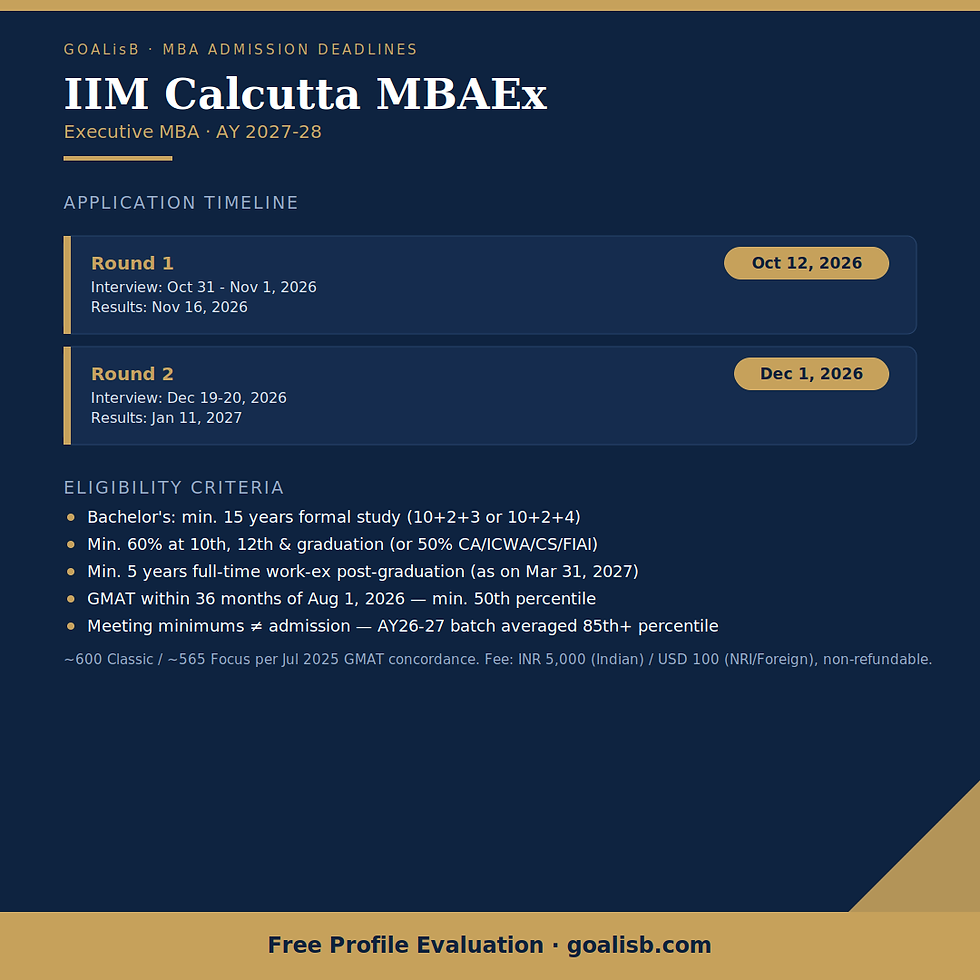
Every year, IIM Calcutta publishes the batch profile that most applicants skim for two things the deadline and the minimum GMAT score and then set aside. This year buried in Section 4 of the Admissions Policy is a composite-score formula that tells you, in exact percentages, what the institute is actually optimising for when it builds a batch. Once you read it that way, several conventional assumptions about MBAEx prep stop holding up.
1. IIM Calcutta MBAEX Eligibility, at a glance
Criterion | Requirement |
Academic structure | Full-time Bachelor's degree, 15 years of study (10+2+3 or 10+2+4) or equivalent, any discipline |
Class X & XII | Minimum 60% or equivalent at both |
Graduation / PG | Minimum 60% or equivalent, OR 50% for CA/ICWA/CS/FIAI |
Work experience | Minimum 5 years full-time, post-graduation, calculated to 31 March 2027 |
GMAT validity | Score within 36 months of 1 August 2026; test-centre score only — online/take-home GMAT is not valid |
Minimum GMAT | 50th percentile — approx. 600 (Classic) / 565 (Focus) per the July 2025 concordance table |
The floor is nominal, not competitive. The stated minimum is the 50th percentile. The average GMAT score of the AY2026-27 incoming batch was already above the 85th percentile. Treat the eligibility bar as a filing requirement, not a target.
2. IIM Calcutta MBAEX Key dates — Round 1 vs Round 2
Round 1
Application window: August – October 2026
WAT + PI: 31 Oct – 1 Nov 2026
Results announced: 16 November 2026
Round 2
Application window: October – December 2026
WAT + PI: 19–20 December 2026
Final results: 11 January 2027
Round 1 releases only a limited number of offers to candidates at the very top of the rank list. Everyone else — including strong Round 1 performers — is carried forward and re-ranked in a single pooled merit list alongside all Round 2 candidates. There is effectively no downside to applying in Round 1 if you're ready: you get a shot at the early top-slice, with the pooled round as a safety net.
3. IIM Calcutta MBAEX - The composite score — where the real weight sits
Serial No. | Parameter | Weight |
1 | Academic record (Class X 2% + Class XII 3% + Grad/PG 5%) | 10% |
2 | Diversity (sponsorship, gender, academic, sectoral) | 5% |
3 | Work experience | 15% |
4 | GMAT score | 25% |
5 | Written Aptitude Test (WAT) | 15% |
6 | Personal Interview (PI) | 30% |
WAT + PI = 45% of the composite score. That's nearly double the weight of GMAT alone (25%), and more than four times the weight of the entire academic record (10%). A candidate who interviews and writes exceptionally well can out-rank a materially higher GMAT scorer. For applicant coaching, this argues for allocating at least as much runway to WAT/PI preparation — narrative construction, live articulation, structured argument-building — as to a GMAT retake, once a candidate already clears the percentile floor comfortably.
GOALisB™ MBAEx Compass
4. How each parameter is actually scored by IIM Calcutta MBAEX
4.1 Class X & XII marks
Marks obtained | Points (out of 6) |
≥ 90% | 6 |
≥ 85% and < 90% | 5 |
≥ 80% and < 85% | 4 |
≥ 75% and < 80% | 3 |
≥ 70% and < 75% | 2 |
≥ 65% and < 70% | 1 |
4.2 Graduation / Post-graduation / CA / ICWA / CS / FIAI
Grad/PG marks | CA/ICWA/CS/FIAI marks | Points (out of 5) |
≥ 85% | ≥ 63% | 5 |
≥ 80% and < 85% | ≥ 57% and < 63% | 4 |
≥ 75% and < 80% | ≥ 55% and < 57% | 3 |
≥ 70% and < 75% | ≥ 53% and < 55% | 2 |
≥ 65% and < 70% | ≥ 51% and < 53% | 1 |
CGPA is converted per the candidate's university formula; if none exists, CGPA ÷ maximum possible CGPA × 100. Where a candidate holds multiple degrees, the one commensurate with the claimed work experience is used.
4.3 Diversity — capped at 5 points, but stackable
Category | Description | Points |
Sponsorship | Fully sponsored by employer | 2 |
Sponsorship | Non-sponsored | 0 |
Gender | Female / Transgender | 3 |
Gender | Male | 0 |
Academic background | Engineering bachelor's/master's only | 0 |
Academic background | Non-engineering bachelor's | 2 |
Academic background | Dual Law degree (BA/BSc/BCom LLB) | 3 |
Academic background | Non-engineering bachelor's + non-engineering master's, or CA/CS/ICWA/FIAI + non-eng. master's | 3 |
Academic background | Engineering bachelor's + non-engineering master's | 1 |
Academic background | CA/ICWA/CS/FIAI, no bachelor's | 2 |
Academic background | CA/ICWA/CS/FIAI with a bachelor's | 3 |
Sectoral | Defence, government, healthcare/biotech, non-profit, media/entertainment/travel, or sports | 2 |
Diversity rewards a specific archetype. A candidate with a non-engineering bachelor's and a non-engineering master's is already close to the 5-point cap before any sponsorship or gender points are added. A standard engineering-only, male, non-sponsored, private-sector candidate scores 0 here. That's not a reason to manufacture a narrative — it's a reason to know, early, whether this parameter is a lever for a given profile or a closed door, so effort gets redirected to WAT/PI accordingly.
4.4 Work experience — a narrow peak, not a straight line
Completed work experience | Points (out of 6) |
60 – 84 months (5–7 yrs) | 5 |
85 – 108 months (~7–9 yrs) | 6 |
109 – 132 months (~9–11 yrs) | 5 |
133 – 156 months (~11–13 yrs) | 3 |
Above 156 months (13+ yrs) | 2 |
Only full-time, post-degree work experience counts — internships, articleships, and unpaid work are excluded, and every employer's tenure must be backed by a signed letter and payslips (or registration/tax proof for the self-employed).
4.5 GMAT — a continuous score, not a tier
Unlike the academic tables above, GMAT points are computed on a straight-line formula, with no plateau above the minimum:
GMAT points = (A − Minimum Accepted Score) / (B − Minimum Accepted Score) A = candidate's GMAT total score. B = maximum possible score for the edition (800 Classic, 805 Focus). Minimum accepted = 600 Classic / 565 Focus.
Because there's no ceiling effect, every additional point above the floor keeps adding value all the way to a perfect score — worth knowing before assuming a retake past "good enough" isn't worth the effort, especially against a batch that already averages above the 85th percentile.
4.6 IIM Calcutta MBAEX WAT and 4.7 PI
WAT is scored out of 15 directly (WAT points = WAT score). PI is scored as a fraction of the maximum possible interview score: PI points = (A / B), where A is the candidate's score and B is the maximum possible. Together they carry 45% of the composite — the single largest block by a wide margin.
5. What this means for how you prepare
Read together, the tables point to a specific strategic posture rather than a generic "work hard everywhere" instinct:
Interview readiness is the main event. With PI and WAT carrying 45% against GMAT's 25%, a candidate already past the percentile floor gets more marginal return from structured mock interviews, WAT practice under time pressure, and narrative coherence work than from another month of GMAT drilling.
Know your work-experience band early. The 85–108 month window is the only one that scores a full 6 points; both newer and more senior professionals score lower, with a real drop-off past 156 months. A candidate outside the peak band should expect to compensate elsewhere, particularly in the interview.
Diagnose diversity points before investing in a GMAT retake. A candidate already near the 5-point cap on diversity gains little from chasing more of it — effort is better spent on WAT/PI. A candidate at 0–1 points has a genuine gap to close elsewhere in the composite.
Round 1 has no real downside for a ready candidate. Because Round 1 non-selects are pooled into the final merit list rather than eliminated, there's little strategic reason to hold back a strong application to "polish" a GMAT score marginally.
Source: IIM Calcutta Admissions Policy for the MBAEx Programme, AY 2027-28, Batch 21. This article is an independent analysis built from the published policy and is not affiliated with or endorsed by IIM Calcutta; final admission decisions rest solely with the Institute.
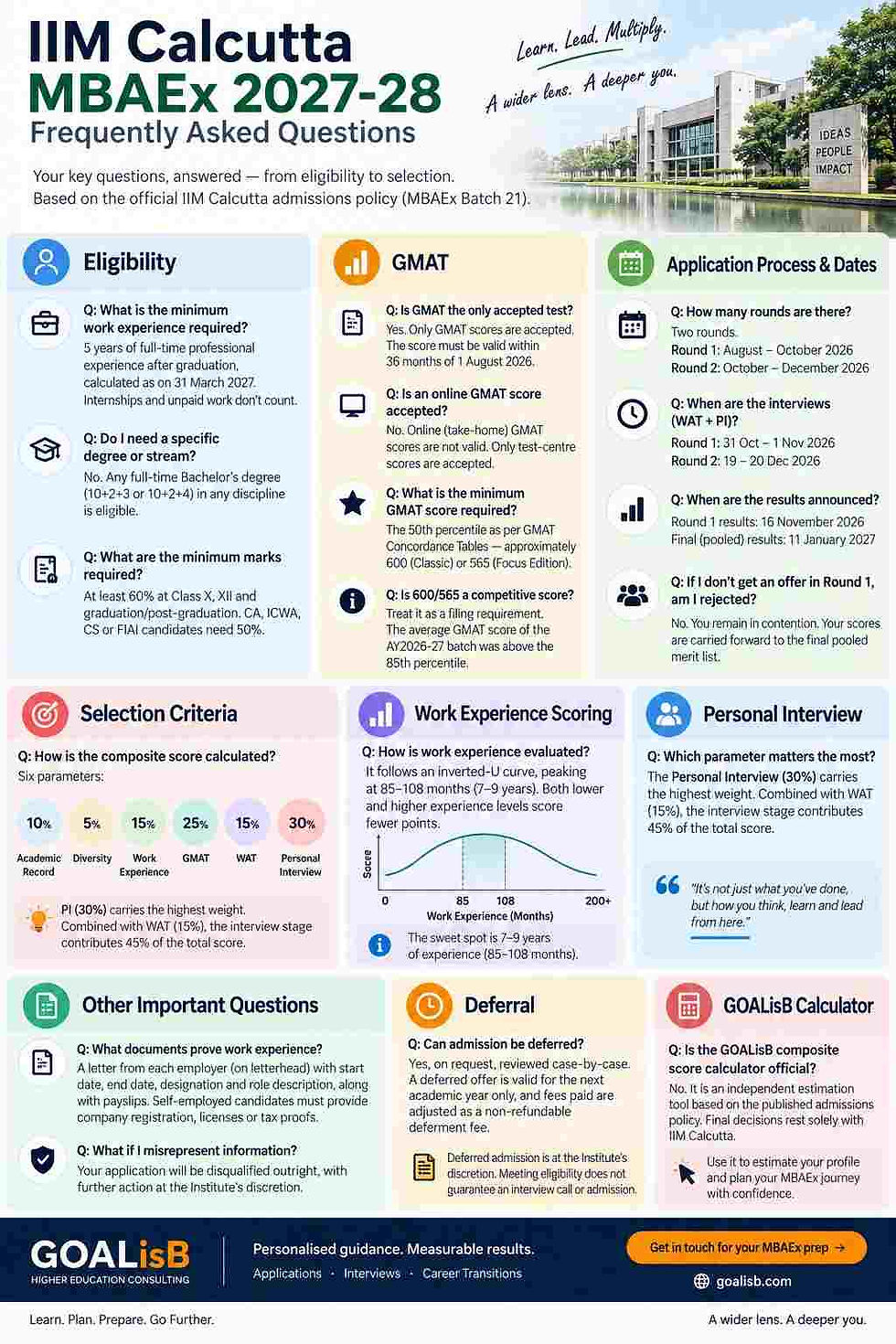
IIM Calcutta MBAEx 2027-28 - Frequently Asked Questions
A detailed answer to nearly every question we field from applicants on the MBAEx Batch 21 (AY 2027-28) process - eligibility, dates, and exactly how the composite score is calculated.
MBAEX Eligibility FAQs
Q: What is the minimum work experience required for MBAEx? A minimum of 5 years of full-time professional experience after your graduation degree, calculated as on 31 March 2027. Only full-time work counts — internships, articleships, apprenticeships, and any unpaid work or work done as part of a curricular requirement are excluded.
Q: Do I need a specific undergraduate degree or stream? No. Any full-time Bachelor's degree with a minimum of 15 years of study (the standard 10+2+3 or 10+2+4 structure) or equivalent, in any discipline, is eligible.
Q: What are the minimum marks required at Class X, Class XII, and graduation? At least 60% (or equivalent) at Class X, Class XII, and graduation/post-graduation. Candidates with a CA, ICWA, CS, or Fellow of the Institute of Actuaries of India (FIAI) qualification instead of a standard degree need at least 50%.
Q: Is GMAT the only accepted test, or can I submit GRE scores? The policy specifies GMAT only. A valid GMAT score, taken within 36 months of 1 August 2026, is required.
Q: Is an online (take-home) GMAT score accepted? No. The policy explicitly states that online GMAT (take-home) exam scores are not valid — only test-centre GMAT scores are accepted.
Q: What is the minimum GMAT score required? The 50th percentile as per the latest GMAT Concordance Tables. As of the July 2025 tables, this works out to approximately 600 for GMAT Classic and 565 for GMAT Focus Edition.
Q: Is the 50th percentile a realistic target, or just a technical minimum? Treat it as a filing requirement, not a competitive target. The average GMAT score of the batch enrolled in AY2026-27 was already above the 85th percentile — so while 600/565 clears eligibility, it will not be competitive against the actual applicant pool.
Q: What if my GMAT percentile falls between two published score bands in the concordance table? The policy specifies that the nearest raw score whose published percentile is at or above the required threshold is used — never a score whose percentile falls below it. In other words, ambiguous cases are resolved in the direction that protects the minimum standard, not in the candidate's favour.
Q: Does meeting all the eligibility criteria guarantee an interview call or admission? No. The policy explicitly states that minimum eligibility at any stage does not automatically qualify a candidate for admission. The number of candidates called for interview each round is at the Institute's discretion, and the eligibility bar is a floor, not a competitive benchmark.
Q: What happens if I misrepresent information in my application? The policy states this shall disqualify the application outright, with any further action left to the Institute's discretion.
MBAEX Application Process and Dates FAQs
Q: How many application rounds are there, and when do they run? Two rounds. Round 1 applications run August–October 2026; Round 2 applications run October–December 2026.
Q: When are the interviews (WAT + PI) held? Round 1: 31 October – 1 November 2026. Round 2: 19–20 December 2026.
Q: When are results announced? Round 1 results: 16 November 2026. Final (pooled) results: 11 January 2027.
Q: If I don't get an offer in Round 1, am I rejected, or still in contention? You remain in contention. Round 1 releases only a limited number of offers to candidates at the very top of the rank list; everyone else's scores remain valid through Round 2, and they're carried forward as waitlisted candidates into a single, final pooled merit list that also includes all Round 2 interviewees.
Q: Is there any downside to applying in Round 1 rather than waiting for Round 2? Practically, no — since Round 1 candidates who aren't selected outright are automatically pooled into the final Round 2 merit list rather than eliminated. Applying early gives you a shot at an early, less crowded top-slice of offers, with the full pooled round still available as a safety net. There is little strategic reason to delay a genuinely ready application.
Q: What documents are required to prove my work experience? A letter from each employer, on company letterhead with an authorised signatory, stating start date, end date, designation, and a brief role description — along with payslips from each employer. Self-employed candidates or those in family businesses must furnish proof of company registration, relevant licenses, or taxes paid where payslips aren't available.
Q: Can admission be deferred to the following year? Yes, on request, reviewed case-by-case at the Institute's discretion. A deferred offer is valid only for the immediately following academic year. Fees already paid are retained and adjusted against the next year's fees as a non-refundable deferment fee, forfeited if the candidate doesn't join the following year.
The MBAEX Composite Score - How Selection Actually Works
Q: What exactly makes up the final composite score?
Six weighted parameters: Academic Record (10%, split as Class X 2% + Class XII 3% + Graduation/PG 5%), Diversity (5%), Work Experience (15%), GMAT (25%), WAT (15%), and PI (30%).
Q: Which single parameter matters most?
Personal Interview (PI) alone, at 30% — the single largest weight of any parameter. Combined with WAT (15%), the interview stage accounts for 45% of the composite score, nearly double GMAT's 25% and more than four times the entire academic record.
Q: Does that mean GMAT doesn't matter much?
It matters, but less than most applicants assume relative to interview performance. GMAT is scored on a continuous formula with no plateau — every point above the eligibility floor adds proportional value all the way to a perfect score — so it is far from irrelevant. The practical implication is about where to invest additional preparation time once you're safely past the percentile floor: WAT/PI readiness has at least as much (arguably more) marginal impact on your final rank as further GMAT gains.
Q: How are Class X and XII marks converted into score contribution?
Points are assigned in bands out of a maximum of 6 (≥90% = 6 points, down to ≥65–70% = 1 point, below 65% scoring 0). Class X contributes at a 2% weight and Class XII at a 3% weight of the total composite.
Q: How are graduation/PG marks converted into score contribution?
Similarly banded, but out of a maximum of 5 points (≥85% = 5 points down to ≥65–70% = 1 point). This parameter carries a 5% weight. CA/ICWA/CS/FIAI candidates have a parallel, lower percentage band mapped to the same point scale.
Q: I have a CGPA, not a percentage. How is that handled?
Converted using your university/institute's official CGPA-to-percentage formula. If no such formula exists, the policy specifies: CGPA ÷ maximum possible CGPA × 100.
Q: I have multiple degrees (e.g., a Bachelor's and a Master's). Which one counts for scoring?
The degree that is commensurate with your claimed full-time work experience is the one used for the composite score calculation.
Q: How is the Diversity score calculated?
Points are awarded across four sub-categories — sponsorship status, gender, academic background, and sectoral background — and summed, but the total is capped at a maximum of 5 points regardless of how many categories apply.
Q: What earns diversity points?
Being fully employer-sponsored (+2); identifying as female or transgender (+3); a non-engineering academic background in various combinations (0–3 points depending on the specific combination of degrees); and working in defence/paramilitary, government, healthcare/biotech, the non-profit sector, media/entertainment/travel, or sports (+2).
Q: My profile scores 0 on Diversity. Does that hurt my chances significantly?
It means this parameter (5% of the total) isn't a lever for you — not that your application is disadvantaged overall. A standard engineering-only, male, private-sector, non-sponsored profile scores 0 here, which simply means the other 95% of the composite — particularly WAT and PI at 45% combined — is where your competitive positioning needs to be built.
Q: How is Work Experience scored — is more always better?
No. Points follow an inverted-U shape, peaking at 6 points for 85–108 completed months (roughly 7–9 years). Both shorter (60–84 months: 5 points) and longer tenures score lower, with a steeper decline past 156 months (13+ years, scoring only 2 points). Candidates outside the 85–108 month sweet spot should expect this parameter to be a smaller contributor and plan to compensate through WAT/PI performance.
Q: What's the exact GMAT scoring formula?
GMAT Points = (Candidate's GMAT Score − Minimum Accepted Score) / (Maximum Possible Score − Minimum Accepted Score). The minimum accepted score and maximum possible score both depend on which edition you took: Classic uses a floor of 600 and a max of 800; Focus uses a floor of 565 and a max of 805.
Q: How is the Written Aptitude Test (WAT) scored?
Directly, your WAT score, out of 15, is your WAT points. There's no additional normalization or curve applied per the stated formula.
Q: How is the Personal Interview (PI) scored?
As a fraction: PI Points = Candidate's PI Score ÷ Maximum Possible PI Score. The specific point scale used by interview panels isn't published, so this is inherently harder for a candidate to self-estimate compared to GMAT or WAT.
Using GOALisB's Composite Score Calculator
Q: How accurate is the calculator's estimated score?
Every individual point-band and formula in the calculator (Class X/XII bands, Grad/PG bands, Diversity categories and cap, Work Experience bands, the GMAT formula, WAT, and PI) is taken directly and verbatim from the published IIM Calcutta Admissions Policy. The one place we've had to make an inference is how the six parameters — which are published on different point scales (out of 6, out of 5, as a 0–1 fraction, out of 15) — combine into a single 0–100 composite. We've applied the mathematically consistent normalization (each parameter's points, scaled to its stated percentage weight), which is the standard way such rubrics are built, but it is not a formula stated explicitly, word-for-word, in the policy document. Because of this, the calculator is labelled as an estimate throughout, not an official score.
Q: Is one part of the Diversity table genuinely ambiguous?
Yes, the sectoral diversity category (defence, government, healthcare, non-profit, media, sports) shows a single "2" in the source document that appears to apply across all six sectors as a merged cell, rather than a distinct point value for each. We've treated all six as worth 2 points, which is the most natural reading, but haven't been able to independently verify it against the Institute's underlying scoring sheet.
Q: Is this calculator affiliated with or endorsed by IIM Calcutta?
No. It's an independent estimation tool built by GOALisB from the publicly available Admissions Policy document. Final admission decisions rest solely with the Institute, and the calculator's output should be read as a directional planning aid rather than a predictive guarantee.
Q: I've run my numbers, what should I do next?
The composite score tells you where the arithmetic places you; it doesn't tell you how to close a gap or which parts of your candidacy to lead with in the interview. That's a conversation, not a calculation - book a free profile review with a GOALisB consultant to work through your specific number.
Source: IIM Calcutta Admissions Policy for the MBAEx Programme, AY 2027-28, Batch 21. This FAQ is an independent analysis by GOALisB Higher Education Consulting and is not affiliated with or endorsed by IIM Calcutta; final admission decisions rest solely with the Institute.