FT MBA Ranking 2026: Beyond the Numbers
FT MBA Ranking 2026: The Ranking That Reshapes Careers
Every January, when the Financial Times releases its Global MBA Ranking, admissions consultants worldwide brace for the inevitable flood of panicked emails.
"My dream school dropped five places, should I reconsider?"
"A school I've never heard of is now in the top 30, is this my hidden gem?"
The 2026 edition of the FT MBA Ranking delivered its usual share of surprises, but beneath the headline-grabbing shifts lies a more nuanced story about the evolving MBA landscape and what it means for your specific career trajectory.
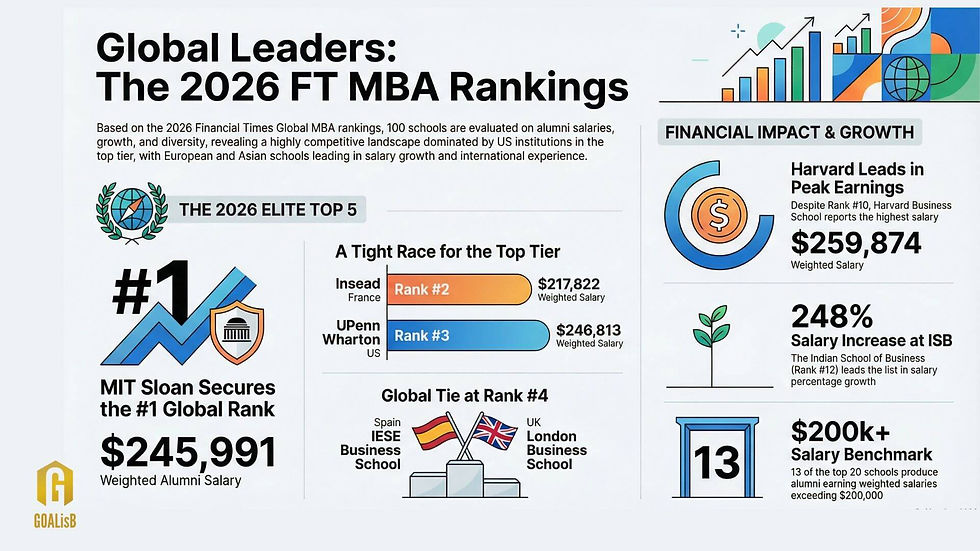
This year's ranking brought historic firsts: MIT Sloan claiming the top spot for the first time in 28 years, Harvard breaking back into the top 10, and nine Indian business schools securing positions in the top 100. But here's what the rankings won't tell you: these movements reflect fundamental shifts in how MBA value is created, measured, and realized across different geographies, career paths, and candidate profiles.
As an MBA admissions consultant who has guided over 5000 candidates to top global programs, I've learned that rankings are simultaneously indispensable and dangerously misleading. They provide crucial data points while obscuring the personalized calculus that should drive your school selection. This analysis goes beyond the surface-level rankings to decode what the 2026 FT data really reveals, and what it deliberately obscures, across regional markets, candidate profiles, and career outcomes.

Understanding the FT MBA Ranking 2026 Methodology: What Gets Measured Gets Managed
Before we dissect regional trends, we must understand what the FT actually measures, and critically, what it doesn't. The ranking employs 21 criteria weighted across three categories, creating a composite score that determines final placement.
The 56% Question: Alumni Outcomes Dominate
More than half the ranking (56%) derives from alumni responses collected three years post-graduation. This isn't arbitrary, it reflects the FT's philosophical stance that MBA value should be judged by career outcomes, not inputs like application selectivity or institutional resources. The two heavyweight criteria are:
Weighted Salary (16%): Average alumni earnings three years post-MBA, adjusted for purchasing power parity and normalized across sectors. This adjustment is crucial, it means a graduate earning $120,000 in consulting gets weighted differently than someone earning $120,000 in nonprofit leadership. The sector adjustment prevents finance-heavy schools from dominating purely through industry selection rather than program quality.
Salary Increase (16%): The differential between pre-MBA and current salary, split evenly between absolute dollar increase and percentage growth. This criterion fundamentally changes the ranking calculus. A candidate moving from $50,000 to $150,000 (200% increase) contributes more ranking value than someone moving from $100,000 to $180,000 (80% increase), even though the absolute gain is similar.
This methodology explains why schools like ISB MBA (Rank 12, 248% salary increase) or SPJIMR (Rank 74, 199% increase) punch above their weight. They're not competing on absolute salary, where Harvard's $259,874 dominates, but on transformation magnitude.
The 34% Middle: School-Controlled Metrics
Diversity measures (gender balance, international composition), faculty credentials, carbon footprint, and ESG teaching account for just over one-third of the ranking. These criteria reward institutional choices but can be strategically managed. Schools can recruit internationally, hire diverse faculty, and commit to carbon targets more easily than they can transform salary outcomes.
The tension here is fascinating: criteria schools can most directly influence carry less weight than alumni outcomes they can only indirectly shape through curriculum, career services, and network building.
The 10% Wildcard: Research Rank
Faculty research output, measured by publications in 50 selected journals, represents 10% of the ranking. This criterion advantages larger faculties at research-intensive universities (Wharton, Booth, MIT) while potentially undervaluing teaching-focused programs or smaller schools with comparable per-capita research output.
For prospective students, this metric matters if you're considering academic or research-adjacent careers. For the vast majority pursuing corporate, consulting, or entrepreneurial paths, this 10% creates noise in your decision-making rather than signal.
What the FT MBA Ranking 2026 Methodology Reveals About Your Priorities
The FT methodology implicitly argues that an MBA's value lies primarily in career acceleration, measured financially. If you share this assumption, that your primary goal is maximizing earnings growth, the FT ranking provides excellent guidance. If your priorities weight differently (entrepreneurial network, geographic flexibility, work-life integration, specific industry access), you'll need to manually reweight the criteria to match your values.
This is where most applicants go wrong. They treat the FT's composite score as universal truth rather than one possible weighting of competing priorities. Your task is to reverse-engineer which criteria matter for YOUR goals, then evaluate schools on that customized framework.
FT MBA Ranking 2026 - The United States: Dominance Under Pressure
Eleven of the top 25 schools are American, maintaining the U.S. as the ranking's gravitational center. Yet this represents a subtle erosion from historical highs, and the internal dynamics of U.S. schools reveal increasing stratification.
The Emerging Tiers
The Untouchable Five (Ranks 1-11): MIT Sloan, Wharton, Berkeley Haas, Harvard, and Kellogg operate in rarefied air. These schools combined deliver average weighted salaries above $220,000, alumni networks that span global Fortune 500 leadership, and brand recognition that transcends ranking fluctuations. The cost? Total program expenses approaching $250,000-300,000 when accounting for tuition, living costs, and foregone salary.
The MIT Sloan ascension to Rank 1 wasn't driven by dramatic program changes but rather the cumulative effect of its tech ecosystem positioning. As technology sector compensation continued growing relative to traditional finance and consulting, Sloan's Silicon Valley pipeline and entrepreneurial focus translated directly into weighted salary advantages. Alumni founding or joining startups that IPO'd or reached unicorn status during the measurement period (2022 graduates surveyed in 2025) benefited from both equity compensation and the tech sector's continued strength.

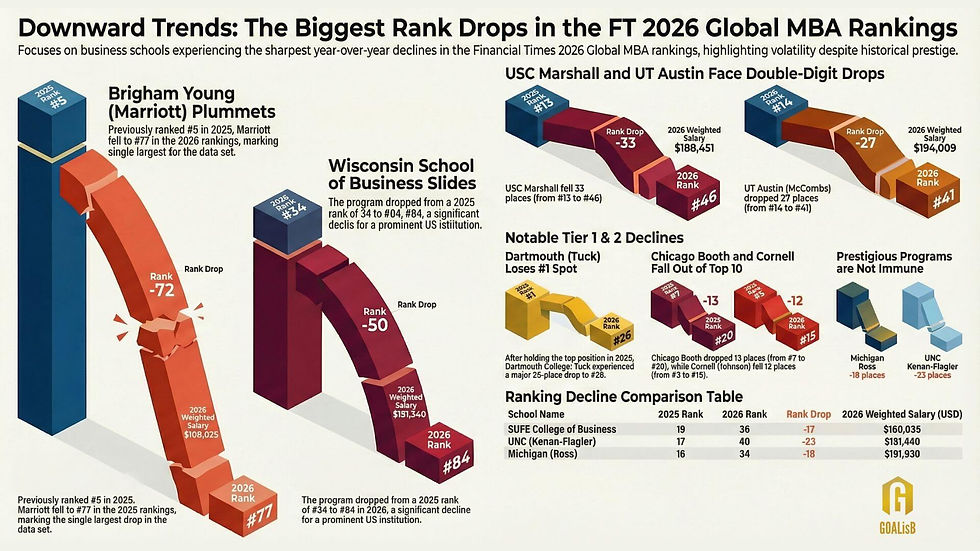
The Strong Core (Ranks 12-30): Cornell Johnson (Rank 15), Duke Fuqua (Rank 16), Yale SOM (Rank 17), Darden (Rank 19), and Chicago Booth (Rank 20) form a competitive tier offering comparable outcomes to the top five at marginally lower costs and often superior student experiences. Booth's ranking at Rank 20 might surprise those familiar with its historically elite positioning, reflecting how research strength (Rank 3) and absolute salary (Rank 231,939) don't fully compensate if career progress and salary increase lag peers.
This tier represents the highest value proposition for candidates with strong but not exceptional profiles (700+ GMAT, 3.5+ GPA, 5-7 years work experience) seeking consulting, finance, or corporate roles without requiring absolute prestige maximization. The $40,000-60,000 savings in total cost compared to Harvard/Wharton translates to meaningful debt reduction while delivering 85-90% of the brand and network value.
The Regional Powerhouses (Ranks 32-50): UCLA Anderson (Rank 32), Michigan Ross (Rank 34), UNC Kenan-Flagler (Rank 40), UT Austin McCombs (Rank 41), and USC Marshall (Rank 46) demonstrate strong regional dominance while struggling for national/international recognition. These schools excel in specific geographies or industries but face headwinds when alumni pursue opportunities outside their core strength zones.
Georgia Tech Scheller's rise to Rank 44 (from Rank 58) exemplifies how regional schools can leverage location advantages. As Atlanta strengthened as a tech hub—Microsoft, Google, and numerous startups expanding presence—Scheller's local pipeline translated into improved outcomes without fundamental program changes. This is the arbitrage opportunity: regional schools whose home cities are appreciating can deliver outsized value before their rankings fully reflect the geographic shift.
The American Value Question
At $120,000-130,000 in tuition alone, American MBAs face an increasingly difficult ROI calculation. A graduate earning $180,000 (respectable but below top-tier averages) with $200,000 in total debt faces 5-7 years of constrained financial flexibility. Compare this to Indian schools where tuition under $30,000 and salary increases of 200%+ create immediate ROI, or European programs offering comparable outcomes at 60-70% of U.S. costs.
The American premium is justified when:
You're targeting U.S.-specific opportunities: Private equity, venture capital, and top-tier strategy consulting (MBB) still recruit disproportionately from U.S. programs
You need the visa platform: F-1 to H-1B to green card pathway, despite challenges, remains more accessible than most countries' immigration routes
Your pre-MBA salary is already high: For candidates earning $100,000+, the absolute salary increase matters more than percentage growth, favoring U.S. programs' higher absolute outcomes
The American premium is questionable when:
You're targeting Asia or Europe careers: Regional programs offer superior local networks at lower cost
You're career switching from low-salary sectors: Percentage increase matters more than absolute salary, favoring transformation-focused programs
You have geographic flexibility: Can optimize for value rather than accepting the U.S. default
U.S. Schools Trending Up vs. Down
Rising: Georgia Tech Scheller (+14), Rice Jones (maintaining Rank 38 with strong energy/healthcare outcomes), Washington Foster (strong tech placement)
Declining: Chicago Booth (historically top 5, now Rank 20), Yale SOM (from top 15 territory to Rank 17, facing stiff competition in Northeast)
Stagnant: Columbia (absent from top 100—requires investigation into response rate or recent graduate outcomes)
The Booth decline is particularly instructive. Despite Rank 3 research ranking and $231,939 average salary, it's slipping because competitors are delivering better career progress, higher salary increases, and stronger value for money. This suggests Booth's traditional quantitative rigor and finance focus may be losing relevance as MBA career paths diversify toward tech, consulting, and entrepreneurship where network and soft skills matter more than financial modeling excellence.
FT MBA Ranking 2026 - Europe: The International Mobility Machine
Nine European schools in the top 25 represent remarkable density given Europe's smaller overall MBA market. European programs compete on a distinct value proposition: international diversity, mobility, and cultural fluency at 60-70% of U.S. costs.
The European Big Four
INSEAD (Rank 2): The France/Singapore model offers unmatched geographic flexibility. With 35% of students moving countries post-MBA and near-universal international student composition, INSEAD delivers on the promise of global mobility. The $217,822 weighted salary—lower than U.S. peers—reflects both European compensation levels and career choice diversity (more international development, social enterprise, family business).
The INSEAD arbitrage for candidates: if you're targeting roles where cultural fluency and international network matter more than absolute compensation—family business succession, international organizations, emerging market private equity—INSEAD delivers premium value at 70% of Wharton's cost.
London Business School (Rank 4): The UK's post-Brexit positioning created uncertainty, yet LBS maintains top 5 status through financial services strength and London's continued relevance as a global business hub. The 98% international student composition creates networks spanning literally every major economy.
HEC Paris (Rank 6): France's distinctive positioning—stronger in luxury, fashion, and European corporates than Anglo-American schools—creates specific industry pipelines. If you're targeting LVMH, L'Oréal, or European private equity, HEC's network provides advantages no U.S. school can match.
IESE (Rank 4): Barcelona's hidden gem combines Rank 2 alumni network ranking with strong ethical business focus. The Jesuit foundation creates distinctive culture emphasizing stakeholder capitalism over shareholder primacy—increasingly relevant as ESG and impact considerations reshape business leadership.

The Spanish Surge in the FT MBA Ranking 2026
Spain claims four top-30 positions (IESE Rank 4, Esade Rank 7, IE Rank 21, ESCP Rank 22), punching far above its economic weight. This reflects deliberate positioning around international diversity, affordable Southern European lifestyle, and English-language programs attracting global cohorts.
IE Business School (Rank 21) deserves special attention: Rank 1 for ESG teaching, strong entrepreneurship focus, and Madrid location offering quality of life at a fraction of London/Paris costs. For candidates targeting impact investing, sustainable business, or European startups, IE delivers specialized positioning the generalist leaders can't match.
ESCP (Rank 22): The multi-campus model (Paris, London, Berlin, Madrid, Turin, Warsaw) creates unmatched European cultural immersion. Rank 1 for international course experience reflects students literally studying in 3-4 different countries during the program. This mobility creates network density across European markets that single-campus programs can't replicate.
The European Value Proposition
European MBAs make strategic sense when:
You're targeting European careers: Local networks matter enormously in relationship-driven European business culture
You value cultural diversity: 90-98% international cohorts vs. 35-50% at U.S. schools
You have family/lifestyle priorities: 12-16 month programs minimize career disruption; European cities offer superior work-life integration
You're cost-sensitive: €60,000-90,000 total cost vs. $200,000+ in U.S.
European programs struggle when:
You need U.S. work authorization: European degrees don't provide U.S. visa pathways
You're targeting U.S. consulting/finance: Firms recruit but with smaller cohort sizes than from U.S. programs
You prioritize absolute salary: European compensation structures lag U.S. by 30-40% for comparable roles
The Brexit Effect: Less Dramatic Than Feared
LBS maintained Rank 4 despite Brexit uncertainty, suggesting brand strength transcends political turbulence. However, the UK's separate tracking from continental Europe in international mobility metrics hints at emerging divergence. Cambridge Judge (Rank 17) and Oxford Saïd (Rank 27) both show strong European student composition but face challenges as European students increasingly prefer continental programs avoiding UK visa complexity.
The opportunity: UK schools may become relatively undervalued as application volumes from Europe soften, creating acceptance opportunities for strong candidates who can navigate UK immigration independently.
FT MBA Ranking 2026 - India: The Transformation Powerhouse
Nine Indian schools in the top 100 represent the ranking's most dramatic geographic shift. This isn't just about quantity, it's about the distinctive value proposition Indian programs offer.
The Salary Increase Leaders
ISB (Rank 12): The 248% salary increase, highest in the entire ranking, reflects the program's transformation power for Indian and Asian professionals. Pre-MBA salaries in Indian industry average $15,000-40,000; post-MBA roles in consulting, finance, or multinational corporates jump to $80,000-120,000 (PPP-adjusted to $200,000+ in the ranking).
This massive percentage increase does more than boost rankings—it signals genuine career transformation. ISB takes mid-level Indian corporate professionals and places them into MBB consulting, global product management, or investment banking roles previously inaccessible without top-tier credentials.
The IIM System: Six IIMs in the top 100 (Ahmedabad Rank 27, Bangalore Rank 34, Calcutta Rank 53, Lucknow Rank 58, Indore Rank 62, Kozhikode Rank 65) provide government-subsidized excellence. Tuition under $25,000 combined with strong corporate placement creates ROI other geographies can't match. IIMA's $227,942 weighted salary at Rank 27 demonstrates top-tier outcomes without top-tier costs.
SPJIMR (Rank 74): The highest new entrant with 199% salary increase illustrates continued upward momentum for strong Indian programs. The 9.0 course satisfaction suggests student experience matches outcomes—not always the case at high-pressure IIMs.

The India-Specific Value Case
Indian MBAs excel for:
Career switchers from low-salary industries: Engineering, government, academia, NGOs—where 200%+ increases are realistic
Indian citizens targeting local markets: Superior local corporate networks than international programs can provide
Budget-conscious high performers: Deliver 70-80% of outcomes at 15-20% of costs
Those prioritizing entrepreneurship: Indian startup ecosystem strength creates venture-backed opportunities
Indian MBAs face limitations for:
International mobility: Despite improving, Indian degrees carry less brand recognition in U.S./European markets than peer-ranked Western schools
Absolute salary targets: Even with PPP adjustment, $200,000 weighted translates to actual salaries of $60,000-90,000 in many cases
Specific industry access: Private equity, hedge funds, top-tier venture capital still recruit primarily from U.S./European programs
The Two-Tier Indian System
Tier 1 (ISB, IIMA PGPX, IIMB EPGP): Genuinely global programs attracting international students and placing into multinational roles. ISB's partnerships with Wharton/Kellogg and IIMA's exchange programs create bridges to Western networks.
Tier 2 (Newer IIMs, SP Jain, XLRI): Strong domestic placement with emerging international recognition. These programs offer exceptional value for India-focused careers but limited global mobility.
The arbitrage: Strong Indian candidates often face pressure to target U.S. programs for perceived prestige. But if your career goals center on India—family business, Indian startups, local private equity—ISB or top IIMs deliver superior relevant networks at a fraction of the cost. The U.S. prestige premium doesn't translate when you're operating in Mumbai or Bangalore markets where local credentials and networks matter most.
FT MBA Ranking 2026 - Asia-Pacific: Fragmented Excellence
Asian programs outside India show varied positioning, from Singapore's international hubs to China's domestic powerhouses to Australia's emerging contenders.
Singapore: The Regional Connector in FT MBA Ranking 2026
NUS (Rank 29) and NTU Nanyang (Rank 12) position Singapore as Asia's MBA hub, analogous to London's role in Europe. Both schools offer:
90%+ international student bodies
Strong placement in Southeast Asian markets (Indonesia, Thailand, Vietnam, Philippines)
Regional headquarters access (many multinationals run Asia-Pacific from Singapore)
Reasonable costs (S$60,000-70,000 tuition vs. $120,000+ in U.S.)
SMU Lee Kong Chian (Rank 57) provides a value alternative with strong local corporate connections but less international reach.
The Singapore value proposition works for candidates targeting ASEAN careers, particularly in:
Regional strategy roles for multinationals
Private equity/venture capital focused on Southeast Asia
Family business professionalization in Southeast Asian markets
Consulting with regional focus
Singapore struggles for candidates targeting:
China-specific opportunities (where Chinese programs have better networks)
U.S./European careers (where Western programs provide better alumni bases)
Tech entrepreneurship (where U.S. ecosystem access matters more)

China: The Domestic Giants in FT MBA Ranking 2026
CEIBS (Rank 8): The clear Chinese leader offers access to Chinese corporate leadership networks that no international program can match. The $202,343 weighted salary reflects strong placement in Chinese multinationals, consulting, and finance.
The CEIBS positioning is explicitly China-centric. If you're targeting careers in Chinese markets—either as local professional or foreigner seeking China expertise—CEIBS provides unmatched access. The tradeoff: limited Western recognition and challenging mobility if Chinese market opportunities don't materialize.
Peking Guanghua (Rank 14) and Fudan (Rank 30) offer alternatives with stronger academic credentials (especially Peking's research strength) but narrower corporate networks than CEIBS's dedicated management focus.
Shanghai CUFE (Rank 36): The finance-focused positioning delivers 177% salary increase (Rank 21), appealing for candidates targeting Chinese financial services specifically.
Hong Kong: The Bridge Position in FT MBA Ranking 2026
HKU (Rank 33) and HKUST (Rank 24) historically positioned as bridges between Chinese and Western business worlds. Post-2020 political changes have complicated this positioning, creating uncertainty about Hong Kong's continued role as regional hub versus increasing integration with mainland China.
For now, Hong Kong programs offer:
English-language instruction appealing to international students
Access to both Chinese and international corporate recruiters
Regional financial services strength
Geography allowing both China exposure and international mobility
The risk: As Hong Kong's autonomy diminishes, these bridge advantages may erode, making the programs less distinctive than Singapore alternatives for international students or Chinese programs for China-focused careers.
Australia: The Rising Contender
AGSM at UNSW (Rank 48) jumped 19 places, driven by Rank 1 carbon footprint ranking and improving career services. Australian programs broadly offer:
Quality of life during program (Sydney, Melbourne lifestyle appeal)
Asia-Pacific regional access without China/Singapore political complexities
Post-study work visas enabling 2-4 years of Australian work experience
Lower costs than U.S./UK alternatives
Australian MBAs make sense for:
Candidates seeking Australian permanent residence (MBA + work experience creates pathway)
Asia-Pacific careers without China specialization
Mining, resources, energy sectors where Australian corporate strength provides networks
Quality-of-life prioritizers willing to accept smaller alumni networks
Australian programs struggle with:
Limited scale (smaller cohorts mean smaller networks)
Geographic isolation from major business centers
Lower absolute salaries reflecting Australian market compensation
Emerging rather than established global brand recognition
Canada: The Quiet Alternative in FT MBA Ranking 2026
Canadian programs occupy an interesting middle ground: lower costs than U.S. programs, immigration pathways comparable to Australia, but stronger brand recognition than Australian alternatives.
The Canadian Value Proposition
Rotman (Rank 81), Ivey (Rank 74), McGill Desautels (Rank 87), and Queen's Smith (Rank 92) cluster in the 70-90 range, offering:
60-70% of U.S. program costs
Post-graduation work permits enabling Canadian experience
Pathway to permanent residence for international students
Access to U.S. market (especially from Toronto) while avoiding U.S. visa complexity
Cultural diversity comparable to international programs
Why Canadian Programs Underperform Rankings
Canadian schools face structural challenges:
Brain drain to U.S.: Top Canadian students often pursue U.S. programs, weakening peer effects
Smaller corporate market: Limited Fortune 500 headquarters compared to U.S.
Geographic concentration: Most opportunities concentrate in Toronto/Vancouver, limiting geographic diversity
Currency effects: Salaries reported in CAD appear lower even after PPP adjustment
The Canadian Opportunity
For specific candidates, Canadian programs offer underrated value:
U.S. citizens seeking Canadian residence: Work in Canada post-MBA, easier permanent residence than U.S. H-1B lottery
International students prioritizing immigration: Canada's Express Entry system provides clearer pathway than U.S. uncertainty
Budget-conscious candidates needing North American credentials: Canadian degree recognized in U.S. market at 60% of cost
Those targeting Canadian market specifically: Mining, energy, financial services where local networks matter
The challenge: Canadian programs lack the specialized positioning of European schools (international mobility) or transformational power of Indian schools (salary increase). They're solid generalists in a ranking system that increasingly rewards distinctive strengths.
Decoding the Top 30 in the FT MBA Ranking 2026: Pattern Recognition
Beyond regional analysis, examining the top 30 holistically reveals strategic patterns in how elite programs differentiate.
The Salary vs. Network Tradeoff
Dartmouth Tuck (Rank 26) illustrates the paradox: Rank 1 for alumni network, Rank 5 for career services, 9.13/10 satisfaction—yet only Rank 26 overall because weighted salary ($211,074) lags top 10 peers. Tuck students clearly value something the FT methodology underweights: tight-knit community and lifelong relationships.
For candidates pursuing private equity, entrepreneurship, or roles where relationship capital determines success, Tuck's Rank 26 ranking dramatically undervalues its true worth. The network density of 280 students per class creates bonds larger programs can't replicate.
Conversely, Harvard (Rank 10) tops salary ($259,874) and career progress but ranks only Rank 11 for alumni network—suggesting that scale and prestige deliver outcomes but not necessarily the intimate community smaller programs provide.
The insight: Determine whether your career success depends more on brand/salary or network depth, then weight schools accordingly.
Research Strength vs. Student Focus
Wharton (Rank 3) maintains Rank 1 research but only Rank 28 for career services. The research powerhouse model prioritizes faculty scholarship over student hand-holding. This works beautifully for self-directed students who leverage Wharton's resources independently but may disappoint those expecting extensive personal guidance.
Cornell Johnson (Rank 15) reverses this: Rank 15 for career services, strong student satisfaction (9.411), but only Rank 6 for research. The teaching-focused model serves most MBA students better—since <5% pursue academic careers—but gets penalized in rankings weighting research at 10%.
The question: Are you sufficiently self-directed to thrive in a research-intensive environment, or do you need structured career support? Your answer should shift which top 30 school you target.
Geographic Specialization
CEIBS (Rank 8) ranks extraordinarily high for a single-country-focused program, reflecting China's market size and growth. IE Business School (Rank 21) similarly punches above weight through European sustainability leadership. Both demonstrate that deep specialization in growing niches (China business, sustainable business) can compete with generalist excellence.
The pattern: Specialized programs rank well when their niche is both substantial (large enough market) and growing (rising demand). This suggests future opportunities for programs specializing in other growth areas—African markets, climate tech, healthcare innovation.
The Value Cohort
NUS MBA (Rank 29), Fudan (Rank 30), and IMD (Rank 30) cluster just outside the top 25, offering 80-85% of top 10 outcomes at 50-60% of costs. For candidates without compelling need to be "top 25," this value cohort deserves serious consideration.
These schools share:
Strong regional networks (Asia-Pacific, China, Europe respectively)
International diversity comparable to top programs
Specialized strengths (NUS in ASEAN, Fudan in China, IMD in Switzerland/EU)
Total costs $40,000-80,000 lower than top 10 alternatives
The arbitrage: Most applicants assume marginal ranking differences (say Rank 20 vs. Rank 30) translate to meaningful outcome differences. Data suggests this is false—outcomes cluster within tiers (1-10, 11-25, 26-50) with more variation within tiers than between adjacent ranks.
Candidate-Specific Decision Frameworks
Rankings provide aggregate data, but your decision requires personalized weighting. Here are frameworks for distinct candidate profiles.
Framework 1: The Career Switcher from Low-Paying Sector
Profile: NGO professional, teacher, government employee, or academic earning $30,000-50,000, targeting consulting or corporate strategy
Optimal criteria weighting:
Salary increase: 40% (your primary objective)
Career services: 20% (you need extensive support for unfamiliar recruiting)
Aims achieved: 15% (transformation track record)
Weighted salary: 10% (matters less since you start low)
Alumni network: 10%
Other: 5%
Top school recommendations:
ISB (Rank 12): 248% increase, proven transformation track record
SP Jain (Rank 74): 199% increase, smaller cohort means more individual attention
IIMB (Rank 34): 165% increase, strong career services (Rank 31)
Duke Fuqua (Rank 16): 129% increase among U.S. schools, Rank 14 career services
Cornell Johnson (Rank 15): Strong career services (Rank 15), tight-knit community supports switchers
Schools to avoid:
Research-intensive programs (Wharton, Booth) where you'll feel behind quantitatively-strong peers
Programs with weak career services (research indicates career switchers need extensive structured support)
Highest-cost programs (ROI timeline extends when starting salary is low)
Framework 2: The High Earner Seeking Incremental Advancement
Profile: Management consultant, investment banker, or tech professional earning $100,000-150,000, targeting partner track, C-suite, or entrepreneurship
Optimal criteria weighting:
Alumni network: 35% (your success depends on relationships)
Weighted salary: 25% (matters but you already earn well)
Aims achieved: 15% (ensuring program delivers on your specific goals)
Career progress: 15% (advancement to senior roles)
Salary increase: 5% (percentage gains will be modest from high base)
Other: 5%
Top school recommendations:
Dartmouth Tuck (Rank 26): Rank 1 network, despite lower ranking overall
IESE (Rank 4): Rank 2 network, strong ethical leadership focus
Harvard (Rank 10): Rank 1 career progress, brand opens any door
MIT Sloan (Rank 1): Tech entrepreneurship ecosystem unmatched
Stanford (if available): Not in FT top 100 due to response rate, but ultimate network school
Schools to avoid:
Large programs where you're one of 500+ (harder to build deep relationships)
Programs over-indexed on salary increase (not your priority)
Pure safety schools far below your profile (network effects diminish with peer quality)
Framework 3: The International Mobility Seeker
Profile: Any nationality, seeking career flexibility across multiple geographies, prioritizing optionality over single market optimization
Optimal criteria weighting:
International mobility: 30%
International course experience: 15%
International students %: 15%
Alumni network: 15%
Weighted salary: 15%
Other: 10%
Top school recommendations:
INSEAD (Rank 2): 96% international students, dual campus, proven mobility
LBS MBA (Rank 4): 94% international, London hub
ESCP (Rank 22): Rank 1 international course experience, multi-campus model
CEIBS (Rank 8): If including China in mobility plans
HEC Paris MBA (Rank 6): Strong European and Asian mobility
Schools to avoid:
U.S. programs with <40% international (limited global network)
Single-country focused programs (IIMA, Chicago Booth)
Programs with weak international career services
Framework 4: The Entrepreneur
Profile: Startup founder or aspiring entrepreneur, seeking ecosystem access, co-founder matching, and venture funding networks
Optimal criteria weighting:
Alumni network: 40% (co-founders, mentors, investors)
Location ecosystem: 25% (not directly in ranking but critical)
Aims achieved: 15% (entrepreneurship-specific outcomes)
Career services: 10% (entrepreneurship support specifically)
Salary: 0% (irrelevant for entrepreneurs)
Other: 10%
Top school recommendations:
MIT Sloan (Rank 1): Cambridge/Boston tech ecosystem, strong venture ties
Stanford MBA (if available): Silicon Valley access unmatched
Berkeley Haas (Rank 9): Bay Area ecosystem, alternative to Stanford
INSEAD MBA (Rank 2): Global startup ecosystem, strong angel networks
IE Business School (Rank 21): European startup ecosystem, entrepreneurship focus
Schools to avoid:
Corporate-focused programs (Darden, Ross)
Locations with weak venture ecosystems (most of Midwest, smaller cities)
Programs measuring success by placement % (pressure to take corporate jobs)
Framework 5: The Diversity Candidate Seeking Inclusive Environment
Profile: Underrepresented gender, ethnicity, sexual orientation, or nationality seeking genuinely inclusive culture
Optimal criteria weighting:
Female students %: 20%
International diversity: 20%
Student satisfaction: 20% (proxy for culture)
Alumni network: 15% (support system)
Career progress: 15% (ensuring no glass ceiling)
Other: 10%
Top school recommendations:
ESCP (Rank 22): 50% female, 100% international, inclusive culture
ESSEC MBA (Rank 24): 55% female, strong diversity commitment
Yale SOM (Rank 17): Mission-driven culture, 44% female
IESE (Rank 4): 50/50 gender, values-based community
Rotman MBA (Rank 81): Strong diversity record, inclusive Canadian culture
Schools to avoid:
Programs <30% female (culture likely less inclusive)
"Old boys club" reputation schools (research required)
Locations with limited diversity in surrounding community
When to Ignore the Rankings?
Having analyzed what rankings reveal, let's examine when they actively mislead.
Position 1: Lower-Ranked Regional Schools Beat Higher-Ranked National Schools for Local Careers
If you're certain about geographic target—say, Texas energy industry—UT Austin McCombs (Rank 41) provides superior networks than higher-ranked programs without Texas presence. The ranking undervalues regional dominance because it measures global outcomes, but most careers are ultimately local.
Evidence: McCombs places more graduates into Texas energy companies than any higher-ranked program. The alumni network density in Houston exceeds that of Harvard or Wharton alumni in the same market. For roles where local relationships determine hiring, regional strength beats global brand.
When this applies: You're certain about geography and target industry aligned with regional school's strength. Risk: If you change geographic/industry plans, the regional school's options narrow dramatically compared to national brands.
Position 2: The Best School is the One That Admits You With Money
Counterintuitive but data-supported: outcomes vary more by individual performance within programs than by school ranking differences of 10-20 positions. A fully-funded offer from Rank 40 school beats a full-pay offer from Rank 25 school for most candidates.
The math: Graduating debt-free from a Rank 40 school enables entrepreneurial risk-taking, geographic flexibility, and career choices that debt-burdened Rank 25 graduates can't afford. The optionality value of zero debt exceeds marginal ranking differences.
When this applies: You're receiving significant scholarship differential (>$50,000) and ranking difference is <25 positions. Exception: When Rank 25 school provides access to specific recruiter (MBB, Goldman Sachs) that doesn't recruit at Rank 40.
Position 3: Satisfaction Matters More Than Salary
Cranfield (Rank 55) achieved 9.56/10 satisfaction—highest in the ranking—while earning only middling salary/ranking. For candidates prioritizing life satisfaction over earnings maximization, Cranfield delivers better outcomes than higher-ranked, higher-stress alternatives.
The research: Happiness economics suggests income effects on wellbeing plateau around $100,000-120,000. Most ranked MBA graduates exceed this threshold, meaning marginal salary differences ($180,000 vs. $220,000) produce minimal wellbeing differences while stress/culture variations substantially impact life satisfaction.
When this applies: You've achieved financial security, prioritize work-life integration, or are pursuing MBA for personal growth rather than pure career acceleration.
Position 4: Specialized Rankings Matter More Than General Rankings
For specific career paths, specialized rankings (entrepreneurship, finance, social impact) predict outcomes better than general rankings. A school ranked Rank 60 overall but Rank 3 for entrepreneurship serves aspiring founders better than Rank 15 overall with weak entrepreneurship ranking.
When this applies: You have career clarity and can identify your specific criterion. Risk: Career plans change, and specialized strength may not transfer if you pivot.
Position 5: The Rankings Are Three Years Backward-Looking
The FT surveys graduates three years post-MBA, meaning 2026 rankings reflect students who started programs in 2019-2020. Rapid program changes—new curriculum, new career services leadership, new partnerships—aren't captured for 5-6 years.
Practical implication: Research recent program changes independent of rankings. A school investing heavily in tech curriculum, hiring industry-experienced career counselors, or building new corporate partnerships may deliver better current outcomes than rankings (based on historical data) suggest.
When this applies: You identify programs with recent significant positive changes (leadership, resources, positioning) not yet reflected in ranking data.
Conclusion: From Rankings to Decisions
The FT Global MBA Ranking 2026 provides invaluable data points: MIT Sloan's ascension validates tech-focused positioning; ISB's transformation power confirms ROI for emerging market candidates; European programs' international diversity appeals to mobility-seeking students. But treating the ranking as decision oracle rather than decision input leads to suboptimal choices.
Your optimal MBA program depends on variables the rankings can't capture: your specific career trajectory, geographic preferences, learning style, financial constraints, and values. The ranking tells you which programs delivered historical outcomes for aggregate cohorts. Your task is translating aggregate historical data into personalized future predictions.
The most sophisticated ranking users:
Identify their decision criteria and weights: What matters specifically to YOU, not to the average MBA student
Manually reweight ranking data: Calculate custom scores emphasizing your priorities
Investigate recent program changes: Look for positive developments not yet in ranking data
Consider total cost of attendance: Optimize for ROI, not prestige
Visit programs and speak with current students: Culture and fit matter more than any metric
The 2026 rankings reveal an MBA landscape fragmenting into specialized niches - Indian schools for transformation, European for mobility, U.S. for prestige, Chinese for regional access. This specialization means there's no universal "best" program, only best-for-your-specific-goals programs.
MIT Sloan topped the 2026 ranking, but it's not the top choice for all candidates. For an Indian professional targeting Mumbai private equity, ISB delivers better outcomes. For a sustainability-focused European candidate, IE Business School provides superior positioning. For a Toronto-based consultant seeking Canadian partners track, Rotman's local network exceeds MIT's.
The ranking is the beginning of your analysis, not the end. Use it to identify which schools deliver outcomes that match your goals, then investigate whether their approach, culture, and network align with how you learn and work. The right MBA program transforms your career trajectory—but "right" is individual, not universal, and only you can determine which transformation you're seeking.
Frequently Asked Questions: FT MBA Ranking 2026
How does FT MBA ranking compare to other rankings?
The FT ranking differs significantly from QS, Bloomberg, and US News rankings in methodology and weighting. FT prioritizes alumni outcomes (56% weight on salary and career progression data from graduates three years post-MBA), while QS emphasizes employer reputation and academic indicators, and US News focuses heavily on selectivity metrics like GMAT scores and acceptance rates.
For candidates, this means schools rank differently across systems. MIT Sloan tops FT 2026 but may rank differently in QS. European schools like INSEAD and LBS typically perform better in FT than US News due to FT's emphasis on international diversity and mobility—criteria US News underweights.
Is FT ranking reliable?
Yes, the FT ranking is reliable for measuring career outcomes and salary progression. The methodology surveys actual alumni three years post-graduation, providing real outcome data rather than input metrics. Several schools undergo KPMG audits annually to verify data accuracy.
However, "reliable" doesn't mean "universally applicable." FT measures specific outcomes—primarily salary and career advancement. If you prioritize entrepreneurship, work-life balance, or specific industry access, you'll need to supplement FT data with specialized rankings and direct school research.
Which ranking is better, QS or FT?
Neither is objectively "better"—they measure different things. Choose based on what matters to you:
Use FT ranking when you prioritize: Career outcomes, salary growth, international mobility, actual graduate success, value for money (salary divided by program cost).
Use QS ranking when you prioritize: Academic reputation, employer perception in specific markets, research output, faculty credentials, program diversity.
For most career-focused MBA candidates, FT provides more relevant data because it measures what happens after graduation rather than inputs during application. QS matters more if you're pursuing academic careers or need brand recognition in markets where employer surveys carry weight.
Which MBA ranking is most reliable?
The "most reliable" ranking depends on your career goals:
For salary and career progression: FT Global MBA Ranking (outcome-focused, verified alumni data)
For US-specific careers: US News & World Report (heavy US recruiter familiarity)
For employer brand perception: QS MBA Rankings (includes employer surveys)
For entrepreneurship: Poets & Quants or specialty entrepreneurship rankings
For specific industries: Industry-specific rankings (Financial Times also publishes separate finance MBA rankings)
Rather than finding one "most reliable" ranking, sophisticated applicants triangulate across multiple systems to identify schools that consistently perform well in areas matching their priorities.
What is the most trusted university ranking site?
For MBA programs specifically, the Financial Times, QS, The Economist, and Bloomberg Businessweek are most trusted. Each has distinct credibility:
Financial Times: Trusted for rigorous methodology, verified data, outcome focus. The gold standard for measuring career ROI.
QS: Trusted for comprehensive global coverage, particularly strong for international student perspective.
The Economist: Trusted for value-for-money analysis and career pivot success metrics.
Bloomberg Businessweek: Trusted for employer and student satisfaction surveys, particularly relevant for US market.
Avoid relying solely on any single ranking. Top admissions consultants recommend examining 3-4 ranking systems to identify consistent patterns and school-specific strengths.
Finding the Number One MBA School
Which college is number 1 for MBA?
In FT 2026: MIT Sloan School of Management ranks number one for the first time in the ranking's 28-year history.
In QS 2024: Stanford GSB typically ranks first (though ranking years differ)
In US News 2024: Stanford and Wharton frequently share top positions
The "number one" varies by ranking system because each weights criteria differently. MIT Sloan's FT number-one position reflects strong alumni salaries ($245,991 average), tech sector placement success, and robust alumni network outcomes—all heavily weighted in FT methodology.
For your decision, "number one overall" matters less than "number one for my specific goals." MIT leads FT but may not be optimal if you're targeting European careers (where INSEAD excels), China opportunities (where CEIBS dominates), or career transformation from low-salary backgrounds (where ISB delivers 248% salary increases).
Which is the number one MBA college in India?
In FT 2026: Indian School of Business (ISB) ranks 12th globally and first among Indian schools. ISB achieved the highest salary increase in the entire ranking at 248%.
Among IIMs: IIM Ahmedabad ranks 27th globally, making it the highest-ranked IIM and effectively tier-one alongside ISB for different candidate profiles.
For specific outcomes:
Salary transformation: ISB (248% increase)
Academic rigor: IIM Ahmedabad (Harvard-modeled curriculum)
Tech sector placement: IIM Bangalore (rank 34, located in tech hub)
Cost efficiency: IIM Calcutta (rank 53, lowest tuition among top IIMs)
ISB and IIM Ahmedabad essentially tie for "number one" depending on whether you prioritize transformation (ISB) or traditional prestige and rigor (IIMA).
Which college is best to study MBA?
The "best" college depends entirely on your specific circumstances:
Best for salary maximization: Harvard Business School (average salary $259,874), Wharton, or MIT Sloan
Best for career transformation: ISB (248% increase), SP Jain (199% increase), or IIM Bangalore (165% increase)
Best for international mobility: INSEAD (96% international students, dual-campus), LBS, or ESCP (multi-campus model)
Best for entrepreneurship: MIT Sloan, Stanford GSB, or Berkeley Haas (Silicon Valley ecosystem access)
Best for value/ROI: ISB, IIM Ahmedabad, NUS, or HEC Paris (strong outcomes at 30-60% of US costs)
Best for European careers: INSEAD, London Business School, HEC Paris, or IESE
Best for network density: Dartmouth Tuck (number-one alumni network despite rank 26 overall)
Rather than seeking one "best" school, identify your top three priorities (geography, industry, salary vs. transformation, cost constraints) then find schools excelling in those specific dimensions.
Which country is number one for MBA?
United States remains number one globally by multiple measures:
11 of FT's top 25 schools are American
Highest absolute salaries ($180,000-260,000 averages for top programs)
Largest MBA market (over 150,000 students annually)
Strongest recruiting infrastructure (MBB, tech, PE, VC recruit primarily from US programs)
However, "number one" depends on your metrics:
For value/ROI: India (ISB and IIMs deliver 165-248% salary increases at $25,000-40,000 total cost)
For international diversity: Europe (INSEAD, LBS, ESCP average 90-98% international students vs. 35-50% at US schools)
For career transformation: India (highest percentage salary increases globally)
For Asia-Pacific careers: Singapore (NUS, NTU serve as regional hubs)
For work-life integration: Europe (12-16 month programs vs. 24 months in US; better lifestyle quality)
The US leads in absolute prestige and salary outcomes but increasingly faces competition on value, diversity, and regional relevance.
Which MBA is most in demand in India?
By application volume: IIM Ahmedabad and ISB receive the most applications, indicating highest demand.
By placement demand: ISB graduates are most sought-after by consulting firms (MBB places 30-35% of class), followed by IIM Ahmedabad and IIM Bangalore.
By salary outcomes: ISB leads with highest average salary and 248% increase, making it most demanded by candidates seeking income maximization.
By industry-specific demand:
Consulting: ISB, IIM Ahmedabad
Technology: IIM Bangalore (Bangalore location advantage)
Finance: ISB Hyderabad, IIM Calcutta
Family business succession: ISB (one-year format minimizes absence)
Demand also varies by candidate profile. Engineers from tier-2 colleges favor newer IIMs (Lucknow, Indore, Kozhikode) where admission is more accessible. Experienced professionals (5+ years) prefer ISB's one-year format over two-year IIM programs.
Is 70% good in MBA?
For Indian MBA programs: 70% is generally considered good performance, particularly at rigorous programs like IIMs where grading curves are strict. However, placement outcomes depend more on internship performance, interview skills, and pre-MBA profile than grades alone.
For international programs: Grading systems vary too much for direct comparison. US programs often use letter grades where B+ (roughly 85-89%) represents average performance. European programs may use different scales entirely.
What matters more than percentage:
Summer internship performance and conversion
Involvement in clubs, competitions, leadership roles
Networking and relationship-building with alumni
Interview preparation and communication skills
Pre-MBA brand (company, role, accomplishments)
Recruiters rarely focus heavily on MBA grades except for competitive roles (MBB consulting may care; most corporate roles don't). A candidate with 70% who excels at case interviews and demonstrates leadership typically outperforms someone with 85% but weak soft skills.
IIM-Specific Questions
What is the rank of IIM FT?
IIM Ahmedabad: Rank 27 in FT Global MBA Ranking 2026 (highest among all IIMs)
IIM Bangalore: Rank 34
IIM Calcutta: Rank 53
IIM Lucknow: Rank 58
IIM Indore: Rank 62
IIM Kozhikode: Rank 65
Six IIMs appear in the FT top 100, demonstrating strong global competitiveness. IIM Ahmedabad's rank 27 places it ahead of many respected international programs including Rotman (81), Ivey (74), and McGill (87).
What is the rank of IIM Indore in FT rank 2025?
IIM Indore ranks 62 in the FT Global MBA Ranking 2026 (data collected in 2025, published 2026). This represents strong performance for a newer IIM, outranking several established international programs.
IIM Indore achieved:
165% salary increase
100% employment within three months
Strong satisfaction scores (8.886/10)
Competitive weighted salary of $163,234
IIM Indore's positioning reflects its growing reputation among newer IIMs (established 1996 vs. IIMA's 1961), offering strong value for candidates seeking IIM credentials at more accessible admission standards than Ahmedabad or Bangalore.
Which are the top 3 IIMs?
By FT Global MBA Ranking 2026:
IIM Ahmedabad (Rank 27) - Highest salary ($227,942), strongest brand legacy, Harvard-modeled curriculum
IIM Bangalore (Rank 34) - Tech sector strength, Bangalore location advantage, 165% salary increase
IIM Calcutta (Rank 53) - Strong finance placement, lowest cost among top IIMs, Kolkata corporate connections
By traditional prestige in India: The top 3 IIMs have always been Ahmedabad, Bangalore, and Calcutta (the "ABC" IIMs established in early 1960s). This historical status remains relevant for Indian market reputation.
By specific strengths:
Academic rigor: Ahmedabad
Tech placement: Bangalore
Finance placement: Calcutta
Teaching quality: Bangalore (consistently high faculty ratings)
Value/cost: Calcutta (lowest tuition, strong outcomes)
All three offer significantly lower costs than ISB ($15,000-25,000 vs. $30,000-40,000) with comparable placement, making them exceptional value for candidates certain about India-based careers.
Is IIM Bangalore Tier 1 or Tier 2?
IIM Bangalore is definitively Tier 1 both in Indian context and increasingly in global recognition:
Evidence of Tier-1 status:
Ranks 34 globally in FT 2026 (ahead of prestigious programs like Michigan Ross, UT Austin McCombs, USC Marshall)
Achieves 165% salary increase (rank 31 globally for this metric)
100% placement within three months
Member of elite "ABC" IIMs (Ahmedabad, Bangalore, Calcutta)
Weighted salary of $187,973—comparable to many US programs
Global tier positioning:
Tier 1 Global: Ranks 1-30 (Harvard, Wharton, MIT, INSEAD, ISB)
Tier 1.5 Global: Ranks 31-50 (IIMB sits here alongside Michigan Ross, IMD, Fudan)
Tier 2 Global: Ranks 51-75
IIMB occupies Tier 1 in Indian context (alongside only IIMA and IIMC traditionally) and Tier 1.5 globally, putting it competitive with strong regional programs worldwide while trailing only the elite global brands.
What are IIM Bangalore's strengths in the FT ranking?
Salary Performance:
Weighted salary: $187,973 (competitive globally)
Salary increase: 165% (rank 31 globally—exceptional transformation)
Value for money: Strong (high salary divided by low cost)
Career Outcomes:
100% employment within 3 months
Career progress rank: 4 (fourth globally for advancement in seniority and company size)
Aims achieved: 85% of graduates fulfilled their MBA goals
Unique Advantages:
Location: Bangalore is India's Silicon Valley—access to Google, Microsoft, Amazon, hundreds of startups creates tech placement pipeline other IIMs can't match
Cost efficiency: Total cost under $25,000 vs. $200,000+ for comparable global programs
Transformation power: Takes Indian engineers earning $20,000-40,000 and places them into $80,000-120,000 roles
Areas for improvement:
International recognition (improving but still behind ISB internationally)
Research output (ranks lower than IIMA on this metric)
International student percentage (very low compared to global programs)
IIMB's core strength is delivering world-class career transformation at a fraction of global MBA costs, particularly for tech sector careers.
ISB-Specific Questions
What is the rank of ISB in FT?
ISB ranks 12 in the FT Global MBA Ranking 2026, making it the highest-ranked Indian business school globally and one of the top business schools worldwide.
This rank 12 position places ISB ahead of:
Yale School of Management (rank 17)
University of Chicago Booth (rank 20)
IE Business School (rank 21)
All other Indian business schools including IIM Ahmedabad (rank 27)
ISB's rank 12 reflects exceptional performance across FT's key metrics:
Salary increase: 248% (highest in entire ranking)
Alumni network: Rank 6 globally
Weighted salary: $201,712
International diversity: 1% international (unique Indian focus)
Strong career progression outcomes
Is ISB Tier 1 or Tier 2?
ISB is definitively Tier 1 globally, ranking 12th worldwide in FT 2026. In business school rankings, Tier 1 typically comprises roughly the top 20-25 programs globally, where ISB sits comfortably.
Evidence of Tier-1 status:
Ranks ahead of Yale SOM, Chicago Booth, IE Business School
Achieved number-one ranking globally for salary increase (248%)
Ranks 6th globally for alumni network strength
Partnerships with Wharton and Kellogg (both Tier 1 schools)
Attracts international faculty from top global programs
Tier structure for context:
Tier 1 Global: Top 20-25 (Harvard, Wharton, MIT, INSEAD, LBS, ISB)
Tier 2 Global: Ranks 26-50
Tier 3 Global: Ranks 51-100
ISB occupies Tier 1 globally and undisputed number-one position among Indian business schools specifically.
What is the ranking of ISB in the world?
ISB ranks 12th in the world according to FT Global MBA Ranking 2026. This places ISB in the top 12% of ranked business schools globally and top 1% of all business education institutions worldwide.
What is the rank of ISB Executive Education FT rank 2025?
ISB's Executive Education programs rank separately from the full-time MBA. While I don't have access to the specific 2025 Executive Education ranking in the provided data, ISB typically performs strongly in executive education rankings due to:
Large executive education portfolio serving Indian and Asian markets
Partnerships with leading global programs
Custom programs for major Indian corporates
Faculty expertise in family business, emerging markets
For the most current Executive Education rankings, check the Financial Times Executive Education rankings published separately from the MBA ranking (usually released in May annually).
What is the rank of ISB vs IIM?
ISB ranks higher than all IIMs in FT Global MBA Ranking 2026:
ISB: Rank 12
IIM Ahmedabad: Rank 27 (15 positions behind ISB)
IIM Bangalore: Rank 34 (22 positions behind ISB)
IIM Calcutta: Rank 53
IIM Lucknow: Rank 58
IIM Indore: Rank 62
IIM Kozhikode: Rank 65
Why ISB ranks higher:
248% salary increase (highest globally) vs. IIM Ahmedabad's 160%
Stronger international partnerships (Wharton, Kellogg)
One-year format attracts more experienced candidates (average 5+ years vs. 2-3 for IIMs)
Alumni network ranks 6th globally vs. IIMA's rank 21
When IIMs might be preferable despite lower ranking:
Cost: IIMs cost $15,000-25,000 vs. ISB's $30,000-40,000
Traditional prestige in India: "ABC" IIMs have 60-year legacy
Academic rigor: IIM programs more theory-intensive
Age/experience: IIMs accept younger candidates (0-3 years experience)
The ranking difference reflects different positioning: ISB optimizes for career transformation and salary outcomes (heavily weighted in FT), while IIMs emphasize academic foundation and longer-term development.
Which tier is ISB Hyderabad?
ISB Hyderabad is Tier 1 globally (rank 12 in FT 2026) and undisputed Tier 1 in India as the highest-ranked Indian business school.
ISB operates two campuses—Hyderabad (original, established 2001) and Mohali (added 2015). Both campuses deliver the same curriculum, faculty, and credentials. Students can choose campus based on geographic preference, but outcomes and ranking apply equally to both.
Which is India's number one MBA college?
Indian School of Business (ISB) ranks as India's number-one MBA program in FT Global MBA Ranking 2026, sitting at rank 12 globally versus IIM Ahmedabad's rank 27.
However, "number one" depends on specific criteria:
ISB ranks first for:
Global ranking (12 vs. IIMA's 27)
Salary increase (248% vs. IIMA's 160%)
Alumni network (rank 6 vs. IIMA's rank 21)
International partnerships and global recognition
IIM Ahmedabad ranks first for:
Traditional prestige in Indian market (60-year legacy)
Academic rigor and theory foundation
For career transformation and salary outcomes—what FT measures—ISB is definitively number one. For traditional academic prestige and theoretical foundation, IIMA holds advantages. Most candidates choosing between them should decide based on career goals, budget, and preferred program format.